
Mastering VPasCode: AI-Driven AWS Cloud Architecture via Diagram as Code
In the realm of technical documentation and system architecture, clarity is paramount. Visual Paradigm VPasCode serves as a sophisticated bridge between natural language concepts and precise technical diagrams. This tutorial explores the system architecture of this AI-enhanced tool, focusing on how it manages the complexity of cloud infrastructure modeling—specifically within an AWS environment—and how its integrated AI features resolve common developer challenges.
The Architecture of Cloud Infrastructure Modeling
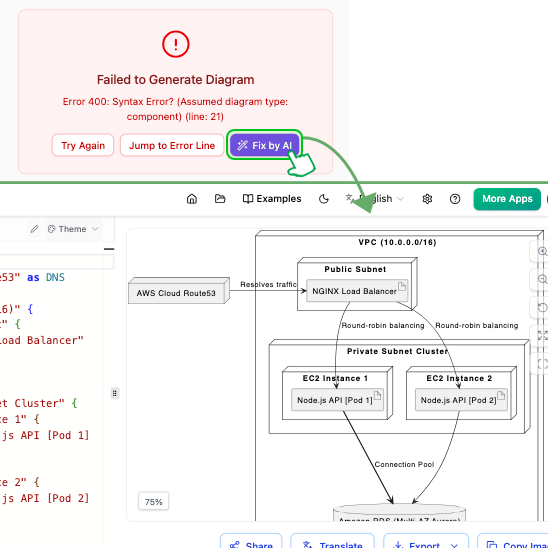
Before diving into the AI capabilities, it is essential to understand the structural logic of the diagram depicted in the context. The image showcases a standard AWS VPC (Virtual Private Cloud) architecture. This is a critical component for enterprise security, isolating resources from the public internet.
Key Structural Components
The diagram illustrates a sophisticated data flow involving public and private subnets:
- VPC Boundary: The outer container (10.0.0.0/16) defines the logical network boundary.
- Public Subnet: This tier hosts the Nginx Load Balancer. It is the entry point for external traffic, receiving requests via AWS Cloud Route53.
- Private Subnet Cluster: This is the secure backend. It contains EC2 Instances running Node.js API pods. These instances do not have direct public internet access, enhancing security.
- Data Persistence: The architecture connects to an Aurora RDS database, utilizing a Connection Pool to manage database efficiency.
Handling Syntax Errors with AI
One of the most significant hurdles in coding-based diagramming is syntax accuracy. A single misplaced bracket or incorrect keyword can prevent a diagram from rendering. The provided image highlights a critical feature of VPasCode: the AI Syntax Fixer.
The Error Scenario
In the image, the user encounters a Error 400 indicating a Syntax Error at line 21. The system attempted to generate a component diagram but failed, displaying a “Failed to Generate Diagram” alert. This is common when dealing with complex nested blocks or specific library requirements.
The AI Solution
Instead of manually hunting through code to find the typo, the user is presented with a Fix by AI button. This feature acts as an intelligent debugger:
- Identification: The AI analyzes the error message (e.g., line 21) and the context of the code.
- Correction: It automatically injects the necessary correction to resolve the syntax issue.
- Learning: By explaining the correction, it helps the user master the specific syntax rules of the diagramming language over time.
Advanced Workflow Features
Beyond fixing errors, VPasCode empowers users to manage complex architectural changes through several AI-driven workflows.
1. Natural Language Generation
You do not need to memorize complex Mermaid or Graphviz syntax. By simply typing a natural language instruction—such as “Create a sequence diagram for a user logging in via OAuth2″—the AI constructs the syntactically correct code instantly. This democratizes diagramming for those who are strong in architecture but weak in coding syntax.
2. Script Modification & Refinement
Architectures evolve. When you need to adjust relationships or add new steps, you can instruct the assistant to modify existing code. This includes injecting blocks, trimming loops, or changing styles without manually hunting through strings of text.
3. Global Collaboration via Translation
For international projects, diagram text can be a barrier. VPasCode includes an AI translation feature to instantly convert diagram text into different languages, facilitating smoother global collaboration.
4. Enterprise Privacy & Custom Endpoints
Data privacy is a top concern for enterprises. VPasCode supports custom AI endpoint integration. Enterprise users can integrate their own API credentials from providers like OpenAI, Anthropic, Google, DeepSeek, Mistral, Qwen, and Groq. This ensures you retain complete management over data handling and operational costs.
Conclusion
Visual Paradigm VPasCode represents the next generation of technical modeling. By combining the precision of diagramming code with the adaptability of Artificial Intelligence, it eliminates the friction of syntax errors and allows architects to focus on the logic of the system—such as the secure routing of traffic through a VPC to an EC2 cluster.