
Mastering Visual Modeling with VPasCode: From Text to Diagrams
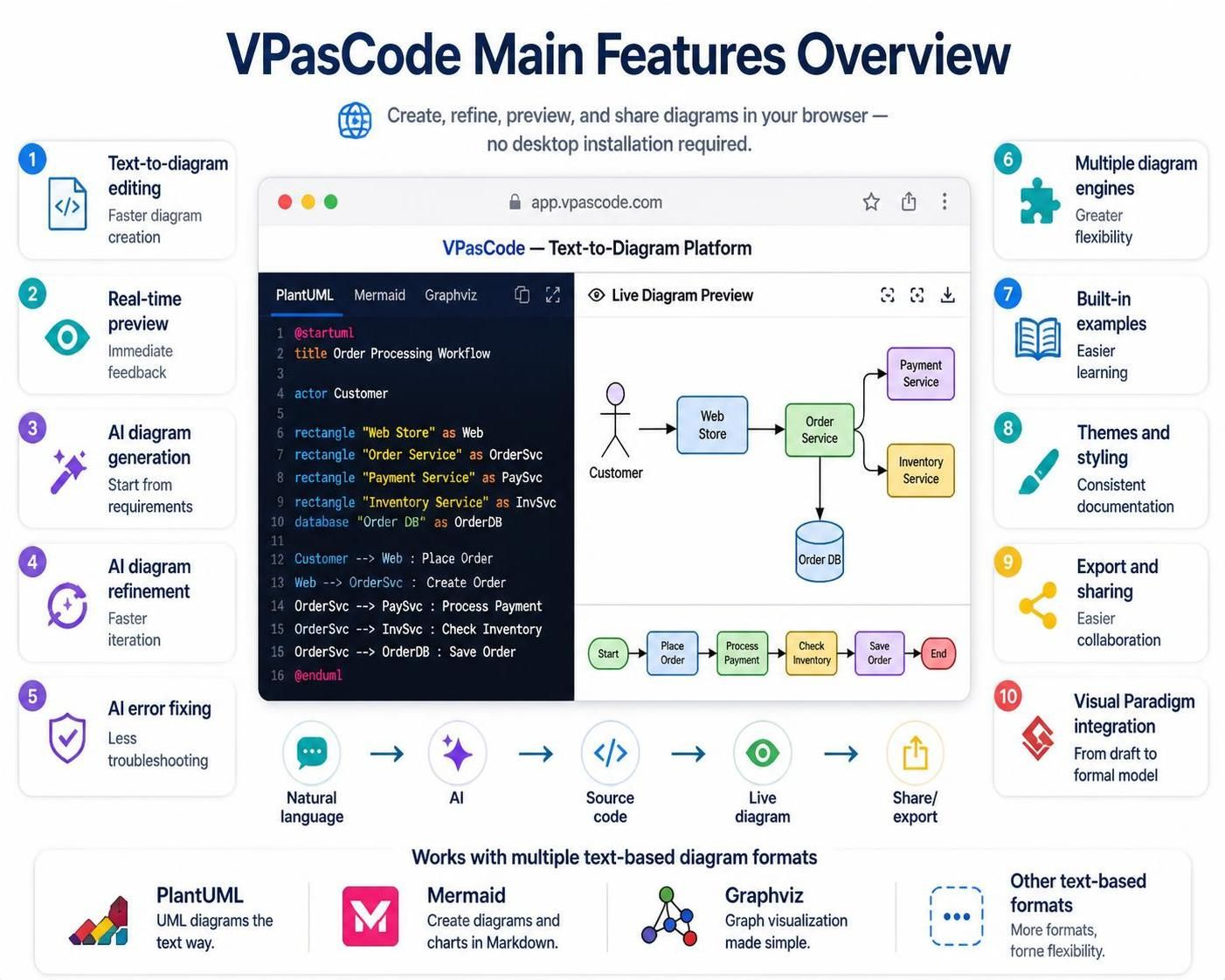
In the modern software development lifecycle, the gap between abstract requirements and concrete architectural models can often lead to communication breakdowns. VPasCode bridges this divide by offering a browser-based, text-driven modeling platform that democratizes the creation of complex diagrams. Whether you are a system architect defining data flows or a developer documenting API interactions, VPasCode transforms plain text into visual representations instantly.
Core Architecture: The Text-to-Diagram Paradigm
At the heart of the VPasCode ecosystem is a powerful engine that interprets human-readable syntax and renders it into professional-grade visualizations. This approach shifts the focus from the tedious drag-and-drop mechanics of traditional GUI-based tools to the precision and speed of code-based definition.
The system operates on a “Live Preview” architecture. When a user types syntax into the editor, the system parses the text and updates the visual canvas in real-time. This immediate feedback loop allows for rapid prototyping and reduces the cognitive load associated with translating logical thoughts into geometric shapes.
The platform supports a multi-engine architecture, meaning it does not rely on a single visualization standard. Instead, it integrates multiple industry-standard diagramming languages:
- PlantUML: Ideal for UML diagrams, sequence diagrams, and architectural structures.
- Mermaid: A markdown-based tool perfect for flowcharts, Gantt charts, and entity relationship diagrams.
- Graphviz: A powerful engine for graph visualization, often used for dependency analysis and complex network topologies.
The Role of Artificial Intelligence in Modeling
One of the most transformative features of VPasCode is its integration of AI-driven capabilities. Historically, the barrier to creating technical diagrams was the requirement to memorize specific syntax rules. VPasCode removes this friction through natural language processing.
AI Diagram Generation
Users can start with a blank slate and simply describe their system in plain English. The AI engine analyzes the natural-language description, identifies the entities, relationships, and processes, and generates the corresponding code (e.g., PlantUML or Mermaid) automatically. This is particularly useful during the early requirements gathering phase, where the goal is to capture the “what” before worrying about the “how.”
AI Diagram Refinement
Modeling is an iterative process. As requirements evolve, diagrams must adapt. VPasCode allows users to provide plain-language instructions to the AI to modify existing diagrams. For example, a user might ask the AI to “add a database layer to the order service” or “change the sequence to use a push notification instead of a direct call.” The AI updates the underlying code and the visual representation simultaneously, significantly speeding up the iteration cycle.
Automated Error Correction
Text-based modeling languages are strict; a single missing semicolon or misplaced bracket can break the entire diagram. VPasCode employs AI to detect and correct syntax errors. It acts as a smart compiler, identifying logical inconsistencies or syntax violations and suggesting fixes, which reduces troubleshooting time and helps users learn the correct syntax over time.
Workflow: From Concept to Collaboration
The VPasCode workflow is designed to be linear yet flexible, supporting the entire modeling lifecycle from draft to formal model.
- Input: The process begins with natural language input or manual text entry.
- Processing: The AI engine or the text parser converts this input into source code compatible with the selected diagram engine.
- Visualization: The Live Diagram Preview renders the code into a graphical interface, allowing for immediate visual validation.
- Refinement: Users can cycle back to the text or use AI refinement tools to adjust the model.
- Output: Once finalized, the diagram can be exported as an image or shared via a secure link for team collaboration.
This workflow supports the “Visual Paradigm integration,” allowing diagrams created in the browser to be seamlessly imported into formal modeling tools for deeper analysis, ensuring that the “draft” phase transitions smoothly into a “formal model.”
Advanced Features: Styling and Integration
Beyond basic generation, VPasCode offers robust support for professional documentation standards. The Theme and Styling engine allows users to apply consistent visual styles across all diagrams, ensuring that the documentation looks uniform regardless of the author. This is crucial for maintaining a professional look in enterprise documentation.
Furthermore, the platform includes Built-in Examples and templates. For users new to text-based modeling, these examples provide a starting point, demonstrating best practices for layout, component definition, and relationship mapping. This lowers the learning curve and accelerates adoption.
Conclusion
VPasCode represents a significant evolution in how technical diagrams are created and maintained. By combining the flexibility of text-based definitions with the power of AI assistance, it empowers teams to focus on the logic of their systems rather than the mechanics of drawing them. Whether for real-time collaboration, automated documentation, or rapid prototyping, VPasCode provides the tools necessary to visualize complexity with clarity and precision.