Enterprise Architecture (EA) functions as the bridge between business strategy and IT execution. However, the most sophisticated architecture model fails if the people involved do not understand, support, or adopt it. This is where stakeholder management becomes the critical differentiator between a theoretical exercise and a driving force for organizational change. Within the framework of The Open Group Architecture Framework (TOGAF), stakeholder management is not a secondary task; it is a foundational discipline woven into the Architecture Development Method (ADM).
This guide details the authoritative practices for managing stakeholders in an enterprise context. We move beyond simple identification to deep engagement strategies that align technical decisions with business value. By focusing on clear communication, structured analysis, and continuous governance, enterprise architects can navigate complex organizational dynamics with precision.
🧭 Understanding the Stakeholder Landscape
Before engaging with individuals, an architect must map the environment. Stakeholders are any individual or group that can affect, be affected by, or perceive themselves to be affected by a decision, activity, or outcome of a project or program. In an enterprise context, this scope is vast.
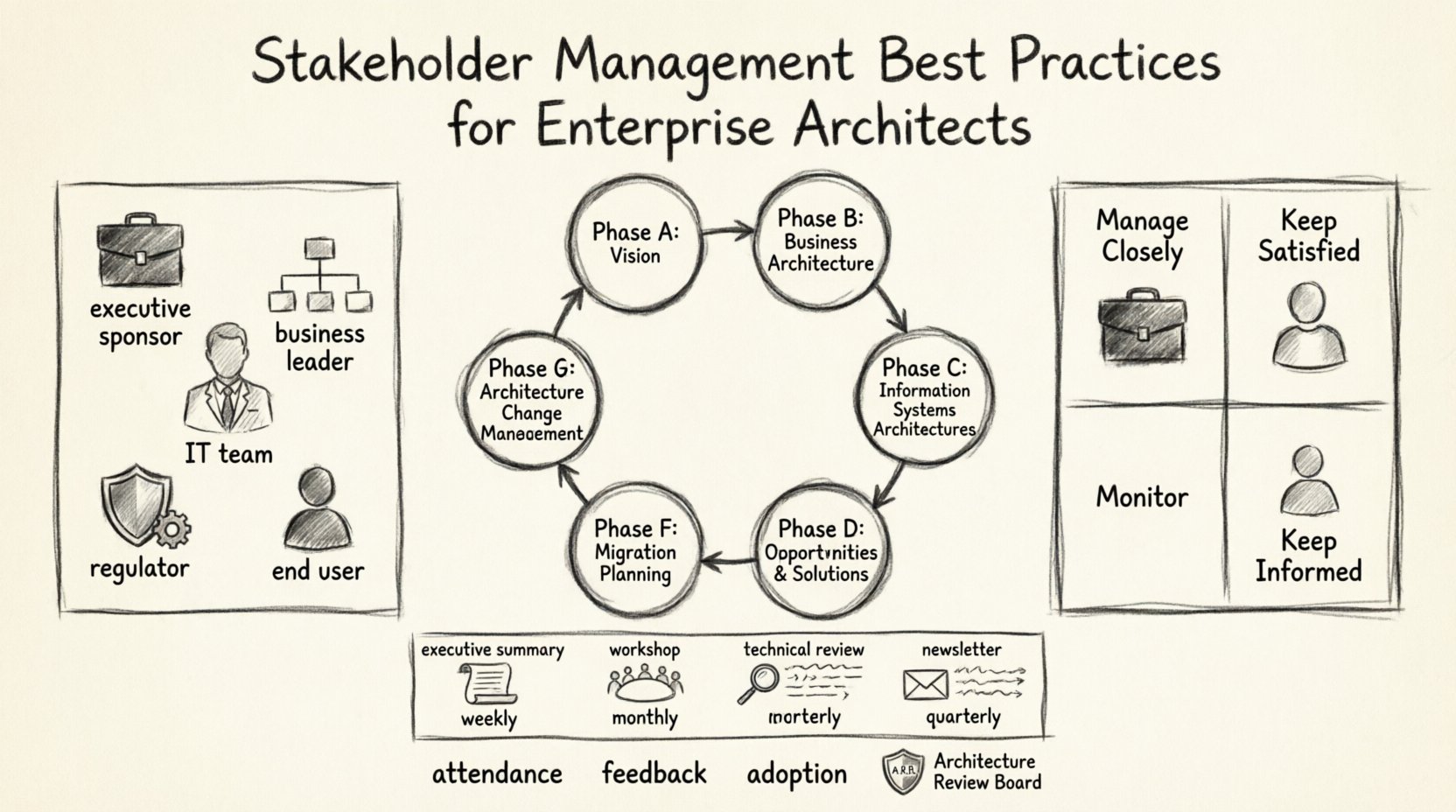
- Executive Sponsors: These individuals provide funding and strategic direction. They care about ROI, risk reduction, and competitive advantage.
- Business Unit Leaders: They focus on operational efficiency, process improvements, and meeting specific departmental goals.
- IT Operations & Development Teams: They are responsible for the implementation, maintenance, and support of the architecture. They care about feasibility, standards, and technical debt.
- Regulators & Compliance Officers: They ensure the organization adheres to legal and industry standards.
- End Users: The daily consumers of the systems. Their adoption rate determines the success of any change.
Recognizing these groups allows for targeted engagement. A one-size-fits-all approach to communication dilutes the message. Each group requires specific information tailored to their concerns.
📋 The TOGAF Approach to Stakeholder Engagement
TOGAF structures stakeholder management across the Architecture Development Method (ADM). It is not a single phase but a recurring activity that spans the entire lifecycle.
Phase A: Architecture Vision
Early engagement is vital. During this phase, you define the scope and identify high-level stakeholders. The goal is to secure initial buy-in and understand the business drivers.
- Identify the key decision-makers who will approve the architecture charter.
- Document the business context and constraints.
- Establish the initial communication channels.
Phase B: Business Architecture
As the architecture takes shape, business stakeholders validate the models. Their input ensures the architecture reflects actual business processes.
- Review business process maps for accuracy.
- Confirm that business capabilities align with strategic goals.
- Gather feedback on proposed changes to operations.
Phase C & D: Information Systems & Technology
Technical stakeholders become more prominent. The focus shifts to integration, data standards, and infrastructure.
- Validate technical feasibility with engineering leads.
- Address security and compliance concerns with risk officers.
- Ensure data governance policies are integrated.
Phase E to H: Opportunities, Planning, Migration, and Implementation
Here, the management of expectations is paramount. Stakeholders need to understand the timeline, costs, and impact of the transition.
- Manage the transition plan visibility.
- Monitor implementation progress against agreed milestones.
- Address emerging issues before they become blockers.
🔍 Techniques for Stakeholder Analysis
Not all stakeholders carry equal weight. Analysis techniques help prioritize engagement efforts. The following matrices are standard tools for categorizing stakeholders based on their influence and interest.
Power/Interest Grid
This grid classifies stakeholders into four quadrants. It dictates the strategy for managing each group.
| Quadrant | Characteristics | Management Strategy |
|---|---|---|
| High Power, High Interest | Key players who can drive success or failure. | Manage Closely: Engage frequently. Keep them fully satisfied. |
| High Power, Low Interest | Individuals who can influence the project but care less about details. | Keep Satisfied: Provide high-level updates. Ensure no objections arise. |
| Low Power, High Interest | Users or staff who are deeply affected by the outcome. | Keep Informed: Communicate regularly. Their feedback is valuable for usability. |
| Low Power, Low Interest | Groups with minimal impact on the project. | Monitor: Minimum effort required. Check in periodically. |
Influence/Impact Matrix
While Power/Interest focuses on hierarchy, Influence/Impact focuses on the ability to affect the outcome and the degree to which the outcome affects them. This is useful for identifying informal leaders who may not hold a senior title but command significant respect.
- High Influence: These are the opinion leaders. Winning them over can sway the rest of the organization.
- High Impact: These are the people whose daily work changes the most. Their resistance can stall adoption.
🗣️ Crafting Effective Communication Plans
Communication is the vehicle for stakeholder management. Without a plan, information flows randomly, leading to confusion and rumor. A structured communication plan defines what information is shared, with whom, when, and how.
Defining Communication Channels
Different audiences prefer different mediums. Using the wrong channel can result in ignored messages.
- Executive Summaries: One-page briefs for C-suite. Focus on cost, risk, and strategic alignment.
- Workshops: Interactive sessions for business architects and process owners. Use for collaborative design.
- Technical Reviews: Detailed sessions for engineering teams. Focus on standards, APIs, and integration.
- Newsletters: Periodic updates for the wider organization to maintain awareness.
- Architecture Repository: A central location where artifacts can be accessed by those who need to find them.
Timing and Frequency
Consistency builds trust. Irregular communication creates anxiety. Establish a rhythm.
- Weekly: For implementation teams and core steering committee members.
- Monthly: For department heads and broader business units.
- Quarterly: For executive sponsors and governance boards.
⚖️ Managing Expectations and Conflict
Change inevitably brings friction. Stakeholders often have competing priorities. One department may want speed, while another demands strict security. The architect acts as a mediator to find the equilibrium.
Navigating Resistance
Resistance is not always negative; it often indicates a valid concern that has not been heard. When facing resistance:
- Listen First: Understand the root cause of the objection. Is it fear of change, lack of understanding, or genuine technical risk?
- Validate Concerns: Acknowledge their input. Do not dismiss their feedback as noise.
- Provide Evidence: Use data and architecture principles to support decisions. Objective criteria reduce subjective bias.
- Offer Alternatives: If a request cannot be met, propose a viable alternative that addresses their underlying need.
Handling Trade-offs
Enterprise architecture is often about trade-offs. You cannot optimize everything simultaneously. Transparency regarding these trade-offs is essential.
- Cost vs. Speed: Explain the long-term maintenance cost of rapid delivery.
- Innovation vs. Stability: Highlight the risks of introducing unproven technologies in critical systems.
- Standardization vs. Customization: Clarify how standards reduce integration complexity versus how customization meets specific niche needs.
🛡️ Governance and Architecture Review Boards
Formal governance structures ensure that stakeholder decisions are applied consistently. The Architecture Review Board (ARB) is a common mechanism for this.
Role of the ARB
The ARB provides a forum for reviewing architectural artifacts and compliance. It ensures that projects align with the enterprise architecture.
- Membership: Should include representatives from business, IT, security, and operations.
- Authority: Must have the power to approve, reject, or request changes to project architectures.
- Process: Clear criteria for what requires review and what can proceed autonomously.
Feedback Loops
Governance is not just about control; it is about learning. Feedback from the ARB should flow back into the architecture itself.
- Document recurring issues identified during reviews.
- Update architecture principles based on real-world constraints.
- Refine the stakeholder map if new decision-makers emerge.
🚫 Common Pitfalls to Avoid
Even experienced architects can fall into traps that undermine their efforts. Awareness of these pitfalls helps maintain focus on the goal.
- Over-Engineering: Creating models that are too complex for stakeholders to understand. Simplicity aids adoption.
- Under-Communicating: Assuming stakeholders know what is happening. Silence is often interpreted as inaction.
- Ignoring Informal Networks: Focusing only on the organizational chart. The informal network often dictates how work actually gets done.
- Technical Jargon: Using terminology that business stakeholders do not understand. Translate technical concepts into business value.
- One-Time Engagement: Treating stakeholder management as a task at the start of the project. It is a continuous process.
📈 Measuring Engagement Success
How do you know if your stakeholder management is working? Quantitative and qualitative metrics provide visibility into the health of relationships and alignment.
Quantitative Metrics
- Attendance Rates: How many stakeholders attend scheduled reviews and workshops?
- Feedback Volume: The number of constructive inputs received versus passive silence.
- Approval Times: How long does it take for stakeholders to approve architecture artifacts?
- Adoption Rates: The percentage of users adopting new systems or processes defined in the architecture.
Qualitative Metrics
- Satisfaction Surveys: Periodic feedback from key stakeholders on their experience.
- Trust Levels: Do stakeholders approach the architecture team for guidance early in the project lifecycle?
- Conflict Resolution: How quickly are disagreements resolved without escalating to executive levels?
🔄 Continuous Improvement in Stakeholder Management
The organizational landscape shifts. New leaders arrive, strategies pivot, and technologies evolve. The stakeholder map is a living document, not a static artifact.
- Regular Reviews: Revisit the stakeholder map every quarter. Identify new influencers and departed contacts.
- Training: Ensure the architecture team has skills in negotiation, presentation, and emotional intelligence.
- Tooling: Maintain a repository of contact information and engagement history to ensure continuity.
- Lessons Learned: After major projects, document what worked in stakeholder engagement and what did not.
🎯 Final Thoughts on Architectural Influence
Successful enterprise architecture relies heavily on the ability to influence without direct authority. You cannot order stakeholders to change their behavior; you must persuade them that the change is in their best interest. This requires a deep understanding of their motivations, a clear articulation of value, and a consistent commitment to transparency.
By adhering to structured practices like those found in TOGAF, and by applying these specific management techniques, architects can transform stakeholder management from a hurdle into a catalyst. The goal is not merely to produce documents, but to foster an environment where the architecture drives business outcomes effectively. This alignment ensures that the enterprise remains agile, compliant, and capable of executing its strategic vision.
Remember that the best architecture is one that is understood and used. Prioritize the human element in your workflow. Invest time in relationships. Listen to the concerns of the business. When you do, the technical decisions become easier to make and easier to accept. This is the core of sustainable enterprise architecture.