Enterprise Architecture (EA) often sits at the intersection of business strategy and technology execution. Without a structured approach, organizations risk fragmentation, redundant investments, and misaligned initiatives. Establishing a Center of Excellence (CoE) for Architecture Governance provides the necessary framework to maintain order while enabling agility. This guide explores how to build, staff, and sustain a robust governance model rooted in TOGAF principles. We will examine the structural components, decision-making flows, and continuous improvement loops required for success. 🚀
Understanding the Architecture Center of Excellence 🧠
A Center of Excellence is not merely a department; it is a hub of expertise that drives standards, shares best practices, and ensures consistency across the organization. In the context of Architecture Governance, the CoE acts as the steward of the enterprise’s architectural assets. It bridges the gap between high-level strategy and operational delivery.
Many organizations struggle with siloed IT decisions. Business units purchase tools without consulting central teams, leading to integration nightmares. A dedicated CoE mitigates this by enforcing policies that balance innovation with stability. The goal is not to stifle progress but to ensure that every investment contributes to the long-term architectural vision. 🛡️
Key characteristics of a successful Architecture CoE include:
- Centralized Authority: Clear ownership of architectural standards and principles.
- Service-Oriented Mindset: The CoE serves business units, providing guidance rather than just policing.
- Knowledge Management: A repository for patterns, standards, and lessons learned.
- Continuous Learning: Keeping pace with emerging technologies and market shifts.
When implemented correctly, the CoE reduces technical debt and accelerates time-to-market. It transforms architecture from a bureaucratic hurdle into a strategic enabler. This shift requires cultural buy-in and clear communication channels. 🤝
Aligning with TOGAF Standards 📐
The Open Group Architecture Framework (TOGAF) provides a proven methodology for designing, planning, implementing, and governing an enterprise information architecture. Integrating TOGAF concepts into the CoE ensures that governance is not ad-hoc but follows a structured lifecycle.
The Architecture Governance Module
TOGAF includes specific guidance on governance. The Architecture Governance Module (AGM) outlines how to manage the architecture throughout its lifecycle. The CoE adopts these mechanisms to oversee compliance and evolution.
Key TOGAF components relevant to the CoE include:
- Architecture Principles: Fundamental rules that guide decision-making. These must be agreed upon by stakeholders before any major project begins.
- Architecture Repository: A central store for all architecture artifacts, including standards, models, and compliance records.
- Architecture Board: The formal body responsible for making decisions on architectural matters.
- Compliance Assessments: Regular reviews to ensure projects adhere to defined standards.
Mapping Governance to the ADM
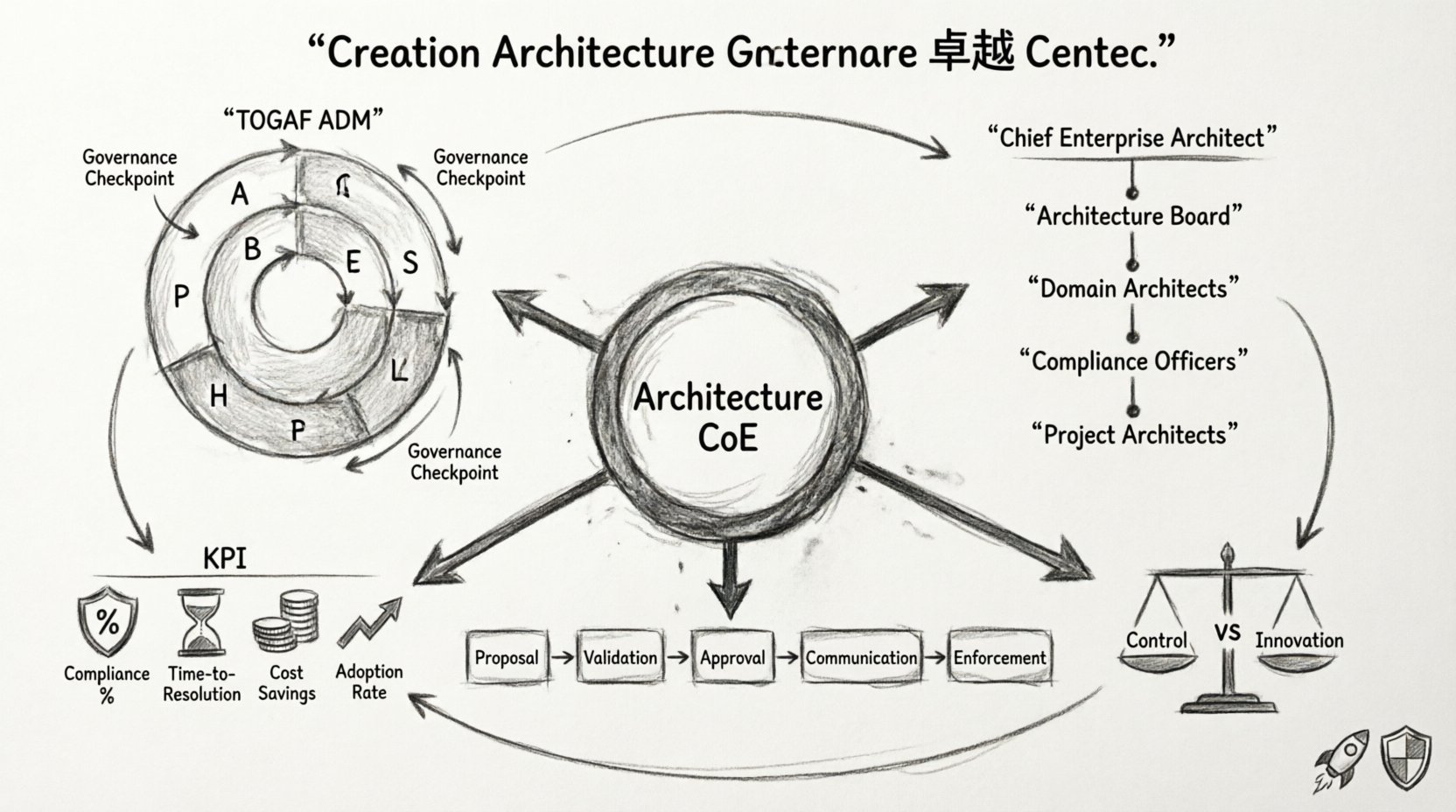
The Architecture Development Method (ADM) is the core cycle of TOGAF. Governance activities should be woven into every phase of the ADM cycle, not just the end. This ensures that decisions are validated early.
| ADM Phase | Governance Focus | CoE Activity |
|---|---|---|
| Phase A (Architecture Vision) | Scope Definition | Validate alignment with strategic intent. |
| Phase B, C, D (Business, Information, Tech) | Design Review | Assess solutions against standards and principles. |
| Phase E (Opportunities & Solutions) | Migration Planning | Ensure transition architectures are feasible. |
| Phase F (Migration Implementation) | Compliance Monitoring | Track actual implementation against design. |
| Phase G (Implementation Governance) | Deviation Management | Manage exceptions and approve changes. |
| Phase H (Change Management) | Evolution Review | Update architecture based on lessons learned. |
This matrix demonstrates that governance is an ongoing process. It is not a gate that opens once and closes. The CoE must maintain visibility throughout the entire project lifecycle. 🔍
Defining Roles and Responsibilities 👥
Success depends on clear roles. Ambiguity leads to finger-pointing when issues arise. A well-defined organizational structure ensures accountability. Below is a breakdown of essential roles within the Architecture CoE.
| Role | Primary Responsibility | Authority Level |
|---|---|---|
| Chief Enterprise Architect (CEA) | Overall strategy and vision alignment. | High |
| Architecture Board Chair | Leads decision-making meetings and escalations. | High |
| Domain Architects | Oversee specific areas (e.g., Data, Security, App). | Medium |
| Compliance Officers | Verify adherence to policies and regulations. | Medium |
| Project Architects | Ensure individual projects follow standards. | Low |
| Stakeholders | Provide business context and requirements. | N/A |
Each role must have defined interaction points. For example, the Domain Architect works closely with the Project Architect to review designs. The CEA reports to the CIO or CTO regarding strategic risks. Clear reporting lines prevent bottlenecks.
It is also vital to define the scope of authority. Does the CoE have veto power? In many organizations, the Architecture Board can block a project if it violates critical principles. However, this power must be exercised judiciously to avoid slowing down innovation. A balance between control and enablement is key. ⚖️
Establishing Governance Processes ⚙️
Processes turn theory into action. Without defined workflows, governance becomes subjective. The CoE must establish standard operating procedures for decision-making, exception handling, and auditing.
The Architecture Review Board (ARB)
The ARB is the operational heart of the governance model. It convenes regularly to review significant architectural proposals. The ARB evaluates projects based on:
- Alignment: Does this support business goals?
- Reusability: Can components be shared across the enterprise?
- Cost: Is the investment justified?
- Risk: Are there security or stability concerns?
Meeting minutes and decisions must be recorded and published. Transparency builds trust. If a project is rejected, the feedback must be constructive, offering alternatives rather than just saying “no.” 📝
Architecture Principles Management
Principles are the laws of the architecture. They should be few, memorable, and enforceable. A CoE manages the lifecycle of these principles.
The process involves:
- Proposal: Stakeholders suggest new principles or changes.
- Validation: The CoE checks for conflicts with existing principles.
- Approval: Formal sign-off by the Architecture Board.
- Communication: Dissemination to all teams.
- Enforcement: Checking compliance during reviews.
Principles often fall into categories such as Technology, Data, or Business. For instance, a principle might state “Buy before build.” This guides procurement teams to look for commercial solutions before developing custom code. 🛒
Metrics and Performance Measurement 📊
You cannot improve what you do not measure. The CoE needs a set of Key Performance Indicators (KPIs) to demonstrate value. These metrics should cover compliance, efficiency, and quality.
| Metric Category | Example KPI | Target |
|---|---|---|
| Compliance | % of Projects Approved on First Review | > 80% |
| Efficiency | Time to Resolve Architecture Issues | < 5 Days |
| Quality | Reduction in Post-Implementation Defects | -10% YoY |
| Value | Cost Savings from Reusable Components | $X Million |
| Adoption | % of Teams Using Architecture Repository | 100% |
These numbers should be reviewed quarterly. If compliance drops, the CoE must investigate whether the standards are too rigid or if communication has failed. If savings are low, the CoE might need to promote existing assets more aggressively. 📉
Reporting should be tailored to the audience. Executives need high-level trends and financial impact. Architects need detailed data on technical debt and component usage. Dashboards can automate this data collection, reducing manual effort. 📈
Common Implementation Challenges ⚠️
Building a CoE is difficult. Even with a solid plan, obstacles arise. Understanding these pitfalls helps in mitigation.
Resistance to Change
Teams often view governance as red tape. They may feel it slows down their ability to deliver features. To counter this, the CoE must demonstrate speed. If the governance process is faster than the alternative (chaos), adoption increases. 🐢➡️🐇
Lack of Executive Sponsorship
Without top-level support, the CoE lacks teeth. If the CIO does not back the Architecture Board, projects will bypass them. Securing a champion at the leadership level is critical for authority.
Scope Creep
The CoE can try to control everything, leading to paralysis. It is better to focus on high-risk, high-value areas. Low-risk operational changes can have lighter touch governance. 🎯
Skill Gaps
Finding architects who understand both business and technology is hard. Investment in training and certification is necessary. The CoE should act as a training ground for junior architects.
Sustaining Long-Term Value 🌱
Once established, the CoE must evolve. Technology changes rapidly. What is relevant today may be obsolete in two years. The governance model must be flexible enough to adapt.
Feedback Loops
Create formal channels for feedback. After every project, ask the team: “Did governance help or hinder?” This qualitative data is as important as the KPIs. Use this to refine processes. 🔄
Knowledge Sharing
Encourage communities of practice. Regular workshops allow architects to share solutions. This prevents reinventing the wheel. The Architecture Repository should be a living document, not a dusty archive. 📚
Integration with Agile
Modern development is often Agile. Traditional governance can clash with sprint cycles. The CoE must integrate into Agile workflows. This might mean lightweight reviews at the sprint level rather than a single gate at the end. 🏃♂️
Technology Evolution
Cloud, AI, and microservices change the architecture landscape. The CoE must update principles to reflect these shifts. For example, principles around “data residency” have become critical with global cloud adoption. 🌍
Conclusion
Establishing a Center of Excellence for Architecture Governance is a strategic imperative. It brings discipline to complexity and ensures that technology investments deliver business value. By aligning with TOGAF, defining clear roles, and measuring performance, organizations can build a resilient architecture function.
Success requires patience and persistence. It is a journey of cultural change, not just a policy update. When done right, the CoE becomes an invisible force that enables speed and innovation while keeping the enterprise stable. The investment in governance pays dividends in reduced risk and optimized operations. 🏆
Start small. Define your principles. Form your board. Measure your progress. Over time, the structure will support the growth of the entire organization. Architecture governance is the foundation upon which digital transformation rests. Build it well. 🏗️