


Building a robust database begins long before writing the first line of code. The foundation lies in understanding the logic that drives the business operations. When business requirements are vague or misunderstood, the resulting data structure becomes fragile. This guide provides a structured approach to converting business rules into an Entity Relationship Diagram (ERD). This process ensures that the database schema accurately reflects organizational needs without relying on specific tools or platforms.
Translating abstract concepts into concrete data models requires precision. A business rule might state, “A customer can place multiple orders, but each order belongs to exactly one customer”. Without proper translation, this logic might be lost or misinterpreted during implementation. By following a systematic framework, technical teams can create schemas that are scalable, maintainable, and aligned with operational realities.
Understanding the Core Components of Business Rules 🧩
Before sketching any diagrams, one must dissect the information provided by stakeholders. Business rules are not just preferences; they are constraints and definitions that govern how data is used and processed. They fall into several categories, each impacting the database design differently.
- Structural Rules: Define what data exists. For example, “Every employee must have a unique ID number.”
- Procedural Rules: Define how data is handled. For example, “Orders over $1000 require manager approval before shipping.”
- State Rules: Define conditions that must be true for specific actions. For example, “An account cannot be closed if the balance is not zero.”
- Transformation Rules: Define how data changes. For example, “Tax rates must be recalculated if the delivery address changes.”
Recognizing these distinctions helps determine where they belong in the data model. Structural rules often become entities and attributes. Procedural rules might become triggers or stored procedures, but they inform the relationships between tables. State rules often dictate constraints and validation logic.
Step 1: Identifying Entities and Attributes 🏢
The first major step in data modeling is identifying the nouns within the business rules. These nouns typically represent the entities. Entities are the real-world objects or concepts about which data is stored. Once entities are identified, the adjectives and descriptors associated with them become attributes.
1.1 Extracting Potential Entities
Review the documentation or interview transcripts for keywords. Look for nouns that are frequently mentioned. For instance, in a retail context, words like Product, Store, Supplier, and Customer are strong candidates.
- Review the text: Highlight every noun that represents a distinct object.
- Filter duplicates: Ensure “Item” and “Product” are not treated as separate entities if they refer to the same concept.
- Check for associations: Some nouns might be attributes of others. “Address” is often an attribute of “Customer”, not a separate entity, unless the system tracks multiple addresses per customer.
1.2 Defining Attributes
Once entities are established, define the data points that describe them. Attributes provide the details needed to identify and describe the entity.
- Primary Keys: Identify the unique identifier for each entity. This is crucial for data integrity.
- Descriptive Attributes: List the properties like names, dates, or descriptions.
- Calculated Attributes: Note values that might need to be derived, though these are often handled in the application layer.
Consider the rule: “A student registers for a course and receives a grade.”
- Entities: Student, Course, Enrollment.
- Attributes: Student ID, Name, Course ID, Title, Grade, Date Registered.
Note that Grade is not an attribute of Student or Course alone. It is specific to the relationship between them. This realization often leads to the creation of an associative entity.
Step 2: Mapping Relationships and Cardinality 🔗
Relationships define how entities interact with one another. The most common source of errors in data modeling occurs when relationships are not clearly defined or when cardinality is misunderstood. Cardinality specifies the number of instances of one entity that can or must relate to instances of another.
2.1 Identifying Relationships
Look for verbs in the business rules. Verbs often signify the relationship between entities. Common verbs include assigns, contains, employs, or purchases.
- One-to-One (1:1): One instance of Entity A relates to exactly one instance of Entity B. Example: An employee has exactly one badge.
- One-to-Many (1:N): One instance of Entity A relates to many instances of Entity B. Example: A department employs many employees.
- Many-to-Many (M:N): Many instances of Entity A relate to many instances of Entity B. Example: Students enroll in many courses, and courses have many students.
2.2 Handling Many-to-Many Relationships
In relational database design, a direct many-to-many relationship is not physically possible. It must be resolved by introducing an associative entity (also known as a junction table or bridge table).
When a business rule states that “A part is used in many assemblies, and an assembly contains many parts”, the translation requires a new entity, such as Assembly_Part_Usage. This new entity holds the foreign keys from both the Part and Assembly entities, plus any attributes specific to that relationship, like quantity.
2.3 Determining Optionality
Cardinality is not just about quantity; it is also about necessity. Does the relationship require a match?
- Required: A relationship must exist. Example: An Order must have a Customer.
- Optional: A relationship may or may not exist. Example: A Customer may or may not have a Middle Name.
Documenting this distinction prevents null value errors and ensures referential integrity constraints are applied correctly.
Step 3: Normalization and Constraint Application ⚖️
Once the initial diagram is drafted, the data must be refined. Normalization is the process of organizing data to reduce redundancy and improve integrity. It is not merely a technical exercise; it is a reflection of business logic efficiency.
3.1 First Normal Form (1NF)
All attributes must contain atomic values. There should be no repeating groups. If a business rule states “A customer has multiple phone numbers”, do not store them in a single column like phone_numbers: '555-1234, 555-5678'. Instead, create a separate row or a related table for phone numbers.
3.2 Second Normal Form (2NF)
Attributes must be fully dependent on the primary key. If an entity has a composite key, no attribute should depend on only part of that key. For example, if a composite key is formed by Student_ID and Course_ID, an attribute like Student_Name should not be stored in the enrollment table. It belongs in the Student table.
3.3 Third Normal Form (3NF)
Attributes must be independent of other non-key attributes. This removes transitive dependencies. If City depends on Zip_Code, and Zip_Code is an attribute of Address, then City should ideally be stored in the Address entity or a linked Zip_Code entity, not duplicated across multiple tables.
Step 4: Validating the Model Against Rules ✅
After the diagram is constructed, it must be validated. This phase ensures that the technical model has not drifted from the original business requirements. A checklist is an effective tool for this validation.
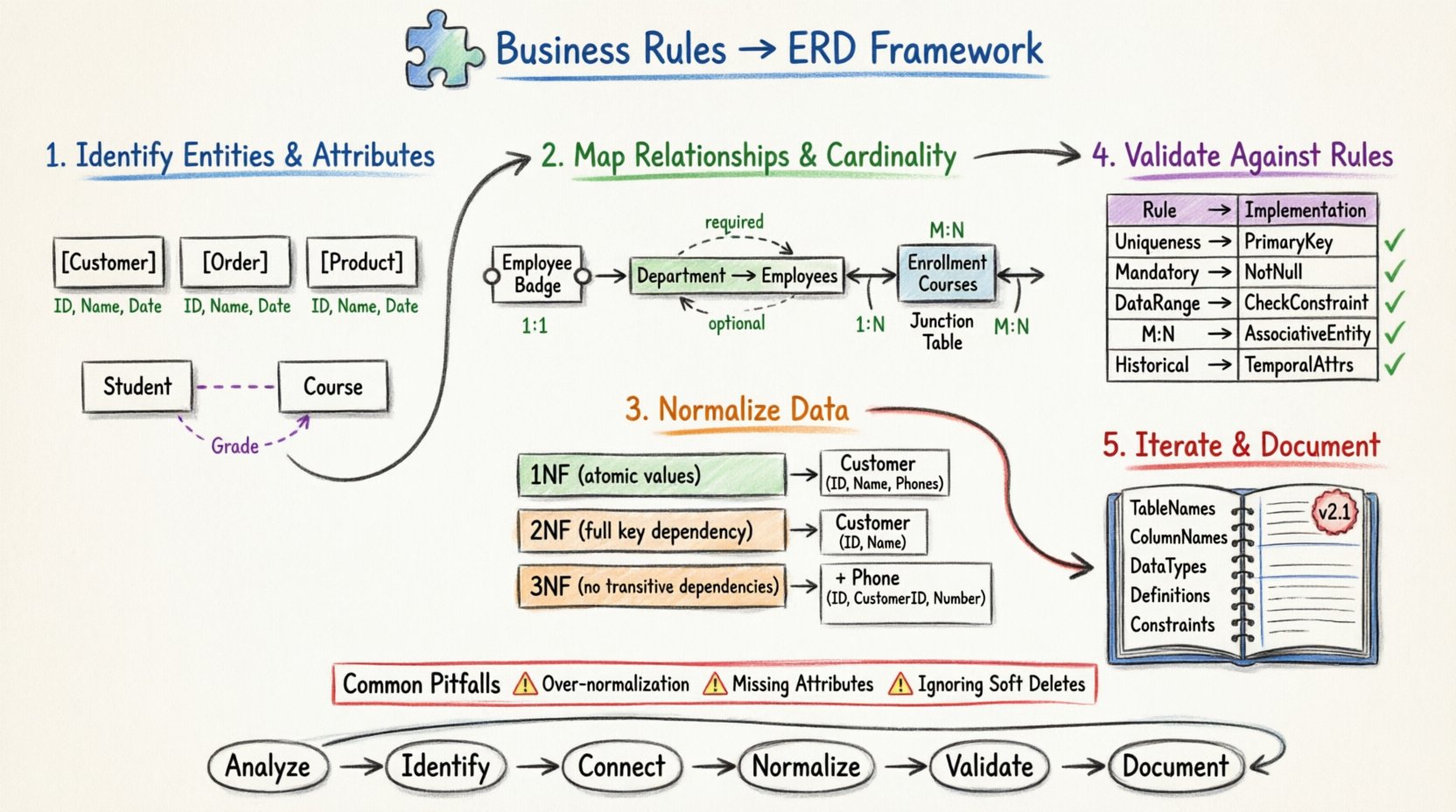
| Business Rule Type | ERD Component | Validation Check |
|---|---|---|
| Uniqueness Constraint | Primary Key / Unique Index | Is every entity uniquely identifiable? |
| Mandatory Relationship | Not Null Constraint | Are foreign keys required where necessary? |
| Data Range | Check Constraints / Data Types | Do numeric fields match expected business limits? |
| Multiple Relationships | Associative Entity | Are M:N relationships resolved into 1:N relationships? |
| Historical Data | Temporal Attributes | Are effective dates included for tracking changes? |
Reviewing this table helps identify gaps. For instance, if a rule states “Prices cannot be negative”, the validation check confirms that the data type and constraints prevent this. If the rule states “A product must belong to a category”, the validation check ensures the foreign key is not nullable.
Common Pitfalls in Translation 🚧
Even experienced modelers encounter recurring issues. Being aware of these common pitfalls can save significant time during the development phase.
- Over-normalization: Breaking tables down too far can lead to excessive joins, slowing down query performance. Balance integrity with performance needs.
- Missing Attributes: Focusing on relationships but forgetting the descriptive data needed for the entity.
- Assuming 1:1 Relationships: Treating a 1:1 relationship as a single table when they should be separate for logical separation or security.
- Ignoring Soft Deletes: Business rules often require data to be retained for history even if marked inactive. The model must account for an
is_activeflag or a separate archive table. - Confusing Attributes with Entities: Treating a list of options (e.g., “Status”) as an entity when it should be a domain constraint or enum value.
Step 5: Iteration and Documentation 📝
Database design is rarely a linear process. Requirements evolve, and the initial model may require adjustment. Documentation is critical here. It serves as the bridge between the technical team and the business stakeholders.
5.1 Maintaining the Data Dictionary
A data dictionary defines the metadata of the database. It should include:
- Table Names: Singular or plural convention.
- Column Names: Clear naming conventions (e.g.,
customer_idvscust_id). - Data Types: Integers, Varchars, Dates, etc.
- Business Definitions: Plain English explanations of what the data represents.
- Constraints: Rules applied to the data.
5.2 Version Control for Models
Just like application code, data models should be versioned. Changes to the schema should be tracked. This ensures that if a regression occurs, the team can revert to a previous state that aligned with the business rules at that time.
Final Thoughts on Alignment 🎯
The translation from business rules to an Entity Relationship Diagram is a critical discipline. It requires listening to stakeholders, interpreting their needs technically, and constructing a model that stands the test of time. A well-structured database reduces technical debt and supports business growth.
When the model aligns with the rules, queries become predictable, reporting becomes accurate, and the system becomes easier to maintain. The effort invested in the translation phase pays dividends during development and maintenance. Focus on clarity, consistency, and validation at every step.
By adhering to this framework, teams can avoid the common trap of building a database that works technically but fails to support the actual business operations. The goal is not just to store data, but to structure information in a way that enables decision-making.
Summary of the Framework 📋
- Analyze: Categorize business rules into structural, procedural, and state types.
- Identify: Extract nouns for entities and adjectives for attributes.
- Connect: Map relationships and resolve many-to-many scenarios.
- Normalize: Apply 1NF, 2NF, and 3NF to reduce redundancy.
- Validate: Cross-reference the model against the original rules.
- Document: Maintain a living data dictionary and version control.
This structured approach ensures that the resulting database schema is not just a collection of tables, but a reflection of the organization’s logic and goals. It transforms abstract requirements into a concrete asset that drives efficiency.
Related posts:
 Entity-Relationship Diagram Fundamentals: Visual Guide for Beginners
 ERD Guide: Entities, Attributes, Relationships: Core Concepts Every Developer Should Know
 ERD Guide: Cardinality and Participation Constraints: Real-World Examples Explained
 ERD Guide: Weak vs Strong Entities: Practical Guidelines for Database Modeling