


Designing the backbone of a financial ecosystem requires more than just connecting databases; it demands a rigorous approach to data modeling. An Entity Relationship Diagram (ERD) serves as the architectural blueprint for how financial information flows, connects, and persists. When dealing with money, precision is non-negotiable. A single misconfigured relationship or an overlooked constraint can lead to discrepancies, audit failures, or regulatory breaches. This guide explores the critical components of building robust Financial Systems ERDs, focusing on maintaining data integrity within complex transaction models.
Understanding Entity Relationship Diagrams in Finance 📊
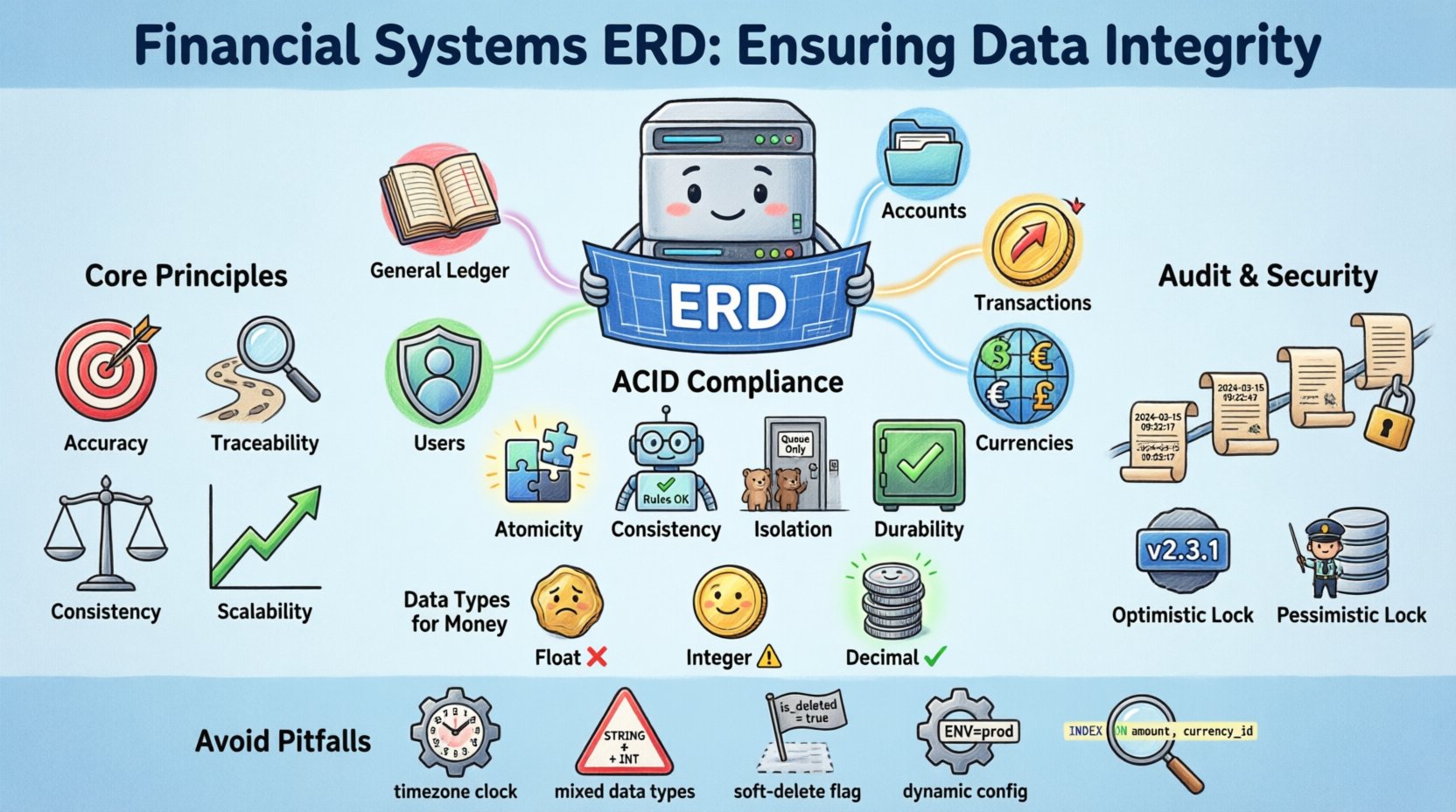
An ERD is a visual representation of the logical structure of a database. In financial contexts, it maps out entities such as accounts, ledgers, transactions, users, and currencies. Unlike general applications, financial systems operate under strict regulatory requirements. The diagram must reflect not just how data is stored, but how it is validated, related, and protected.
When constructing these models, consider the following core principles:
- Accuracy: Every field must represent a real-world financial concept without ambiguity.
- Traceability: Relationships must allow for full audit trails from a transaction back to its origin.
- Consistency: Data types and constraints must enforce mathematical and logical consistency.
- Scalability: The structure should accommodate high volumes of transactional data without degrading performance.
A well-constructed ERD acts as a contract between developers, data analysts, and compliance officers. It ensures that everyone understands how money moves through the system digitally.
Core Components of a Financial ERD 🧩
Financial data models are distinct from typical e-commerce or social platforms. They require specific entities to handle the nuances of currency, balance, and settlement. Below are the fundamental building blocks required for a comprehensive model.
1. The General Ledger
The General Ledger is the central repository for all financial transactions. In an ERD, this is often a central entity or a set of linked tables. It records every debit and credit. Each entry must be balanced against the corresponding credit or debit to ensure the accounting equation holds true.
2. Accounts and Sub-Ledgers
Accounts categorize transactions into assets, liabilities, equity, revenue, and expenses. Sub-ledgers provide the granularity needed for specific departments or products. The relationship between the General Ledger and Sub-ledgers is typically a one-to-many relationship.
3. Transactions and Line Items
Every financial movement is a transaction. Transactions often consist of multiple line items. For example, a payment might involve currency conversion, fees, and principal repayment. The ERD must support a parent-child relationship between the main transaction and its line items to maintain atomicity.
4. Currencies and Exchange Rates
Handling multiple currencies introduces complexity. The model must store the currency code, the exchange rate used at the time of the transaction, and the source of that rate. This ensures that historical reports remain accurate even if exchange rates fluctuate today.
5. Users and Permissions
Security is paramount. The ERD must include entities for users, roles, and permissions. It should track who initiated a transaction, who approved it, and when. This is critical for internal controls and fraud detection.
Designing for Transactional Integrity ⚖️
Data integrity in financial systems is often synonymous with transactional integrity. This means that a transaction must be all-or-nothing. If a transfer fails halfway through, the system must roll back to the state before the operation began. The ERD supports this through specific design patterns.
ACID Compliance in Modeling
Atomicity, Consistency, Isolation, and Durability (ACID) are the pillars of reliable database transactions. The ERD design directly influences how easily these properties are enforced.
- Atomicity: Ensure that related tables are updated within the same transaction block. The ERD should define foreign keys that link these tables tightly.
- Consistency: Use constraints to enforce business rules. For instance, a withdrawal amount cannot exceed the available balance.
- Isolation: The model should support row-level locking or versioning to prevent two processes from modifying the same balance simultaneously.
- Durability: Ensure that once a transaction is committed, the data is stored permanently, even in the event of a power failure.
Handling Financial Precision
One of the most common errors in financial modeling is using floating-point numbers for currency. Floating-point arithmetic introduces rounding errors that accumulate over time. The ERD should specify fixed-point decimal data types for all monetary fields.
| Data Type | Use Case | Financial Suitability |
|---|---|---|
| Float / Double | Scientific calculations | ❌ Not suitable for money |
| Integer (Cents) | Small, single-currency systems | ⚠️ Limited by range |
| Decimal / Numeric | Multi-currency, high precision | ✅ Recommended |
| String | Non-calculable identifiers | ⚠️ Only for IDs, never amounts |
Normalization Strategies for Financial Data 🔄
Normalization reduces redundancy and improves data integrity. However, financial systems often require a balance between strict normalization and query performance. Over-normalizing can make reporting slow, while under-normalizing can lead to update anomalies.
Third Normal Form (3NF)
Aiming for Third Normal Form is generally the best starting point. This ensures that every non-key attribute is dependent only on the primary key. For example, a user’s address should not be repeated in every transaction table. Instead, it should be stored in a separate User Address table referenced by the User ID.
Denormalization for Reporting
While the operational database should be normalized, reporting databases often benefit from denormalization. If you need to generate a balance sheet quickly, joining dozens of tables might be inefficient. In these cases, create summary tables that are updated via batch processes or triggers. The ERD should clearly distinguish between the operational schema and the reporting schema.
Handling Concurrency and Race Conditions ⚡
In high-volume financial systems, multiple users or automated bots may attempt to modify the same account simultaneously. This is known as a race condition. If not handled, it can result in overdrafts or lost funds.
Optimistic vs. Pessimistic Locking
The ERD design influences which locking strategy is viable.
- Optimistic Locking: Uses a version number. If two transactions try to update the same record, the second fails if the version has changed. This requires the schema to include a version column.
- Pessimistic Locking: Locks the row immediately upon read. This prevents other processes from accessing it until the transaction is complete. This is heavier on resources but guarantees safety.
Sequence of Operations
The ERD should enforce a logical order of operations. For instance, a transaction cannot be “Settled” before it is “Authorized”. This can be enforced using state columns with check constraints. A column named status might only allow values like ‘PENDING’, ‘AUTHORIZED’, ‘SETTLED’, or ‘REVERSED’ in that specific sequence.
Audit Trails and Immutable Records 📝
Financial regulations often require that data cannot be altered once written. This is the concept of immutability. While the database schema allows updates, the logical model should treat historical records as read-only.
History Tables
Instead of updating an existing record to reflect a change, create a new record with a timestamp. The old record remains unchanged. This creates an audit trail automatically. The ERD should include a history entity linked to the main entity via a foreign key.
Event Sourcing
A more advanced pattern is Event Sourcing. Instead of storing the current state (the balance), store every event that changed the state (deposit, withdrawal, fee). The current balance is calculated by replaying these events. This provides a perfect audit trail. The ERD for this approach focuses heavily on the Event table structure.
| Feature | Standard Table | Immutable / Event Model |
|---|---|---|
| Data Modification | UPDATE rows | INSERT new rows |
| History | Requires separate logs | Built into the primary model |
| Reconciliation | Complex | Replay events to verify state |
Common Pitfalls in Financial Modeling 🚫
Even experienced architects make mistakes. Identifying common pitfalls early can save significant rework later. Below are frequent errors to avoid during the ERD design phase.
- Ignoring Time Zones: Financial transactions often span time zones. Store all timestamps in UTC to avoid confusion during daylight saving changes or cross-border settlements.
- Mixing Data Types: Do not store currency amounts as integers in one table and decimals in another. Consistency is key for validation scripts.
- Overlooking Soft Deletes: Never physically delete a record. Use a
is_deletedflag or adeleted_attimestamp. Deleted financial records must remain visible for compliance. - Hardcoded Values: Do not hardcode tax rates or fee structures into the database schema. These should be dynamic configuration tables referenced by the transaction logic.
- Missing Indexes: Financial queries often filter by date or transaction ID. Ensure these columns are indexed to maintain performance as data grows.
Validating Schema Logic 🔍
Once the ERD is drafted, it must undergo rigorous validation. This process ensures that the diagram translates correctly into a working system.
Referential Integrity Checks
Verify that every foreign key has a corresponding primary key. Ensure that cascading deletes are configured correctly. If a currency is deleted, what happens to transactions using that currency? Usually, the answer is “nothing”; the currency should be marked inactive, not deleted.
Constraint Testing
Test the constraints defined in the ERD. For example, try to insert a negative balance where the schema expects a positive one. Ensure the database rejects the operation. This confirms that the constraints are active and functioning as intended.
Schema Versioning
Financial systems evolve. Regulations change, and new products launch. The ERD must be versioned. Use migration scripts to move from one version of the schema to another. This allows you to roll back if a migration introduces errors.
Future-Proofing Your Data Architecture 🔮
Technology changes, but financial principles remain stable. A good ERD should be flexible enough to accommodate future needs without requiring a complete rebuild.
- Extensibility: Use JSON columns or extended attribute tables for data that might vary. For example, different payment methods might have different metadata.
- Modularity: Design the ERD in modules. The “User Module” should be separable from the “Transaction Module”. This allows independent scaling and updates.
- Compliance Readiness: Build in fields for data retention policies. If a regulation requires data to be kept for 7 years, the schema should support tagging records for archival.
By anticipating these needs, the model remains robust against change. The goal is to create a system that serves the business today without hindering its growth tomorrow.
Final Thoughts on Financial Data Modeling 🛡️
Building a Financial Systems ERD is a task that blends technical precision with business acumen. It requires a deep understanding of accounting principles and database theory. When executed correctly, the result is a system that users can trust implicitly. Every transaction is accurate, every balance is correct, and every audit trail is complete.
Focus on the relationships as much as the entities. The connections define the flow of value. Ensure that constraints are strict and data types are appropriate. Avoid shortcuts that compromise integrity for speed. In the world of finance, speed is important, but accuracy is everything. By adhering to these guidelines, you establish a foundation that supports stability, compliance, and growth.
Remember to revisit the ERD regularly. As the system matures, the diagram should evolve to reflect new realities. Continuous review ensures that the data model remains aligned with the business objectives. This ongoing diligence is what separates a temporary solution from a lasting financial infrastructure.
Start with the core entities. Define the relationships. Enforce the constraints. Test the limits. And always prioritize the integrity of the data above all else. This approach ensures that the financial system remains a reliable tool for managing value.
Related posts:
 Entity-Relationship Diagram Fundamentals: Visual Guide for Beginners
 ERD Guide: Entities, Attributes, Relationships: Core Concepts Every Developer Should Know
 ERD Guide: Cardinality and Participation Constraints: Real-World Examples Explained
 ERD Guide: Weak vs Strong Entities: Practical Guidelines for Database Modeling