


Participating in a business case competition requires more than just creative ideas. It demands a structured approach to understanding the external landscape where a business operates. The PEST Analysis framework provides this structure. This guide walks through the Political, Economic, Social, and Technological factors relevant to competitive strategy. It is designed to help teams build robust arguments and secure top placements.
🧐 Why PEST Matters in Case Competitions
Judging panels look for depth. They want to see that you understand the context before proposing solutions. A strategy that ignores external forces is often deemed naive. PEST Analysis forces you to look outward. It moves the discussion beyond internal capabilities to the broader environment.
Here is why this framework is essential for your next competition:
- Comprehensive Coverage: It ensures no major external factor is overlooked.
- Strategic Alignment: It connects macro trends to micro decisions.
- Evidence-Based Argumentation: It encourages the use of data and trends rather than assumptions.
- Team Focus: It provides a clear agenda for research during limited prep time.
When you present a case, you are not just selling a product. You are selling a viable path within a specific market context. PEST Analysis validates that path.
📊 Breaking Down the Framework
Each letter represents a distinct category of external influence. Understanding the nuances of each is critical. Below is a detailed breakdown of what to analyze in each section.
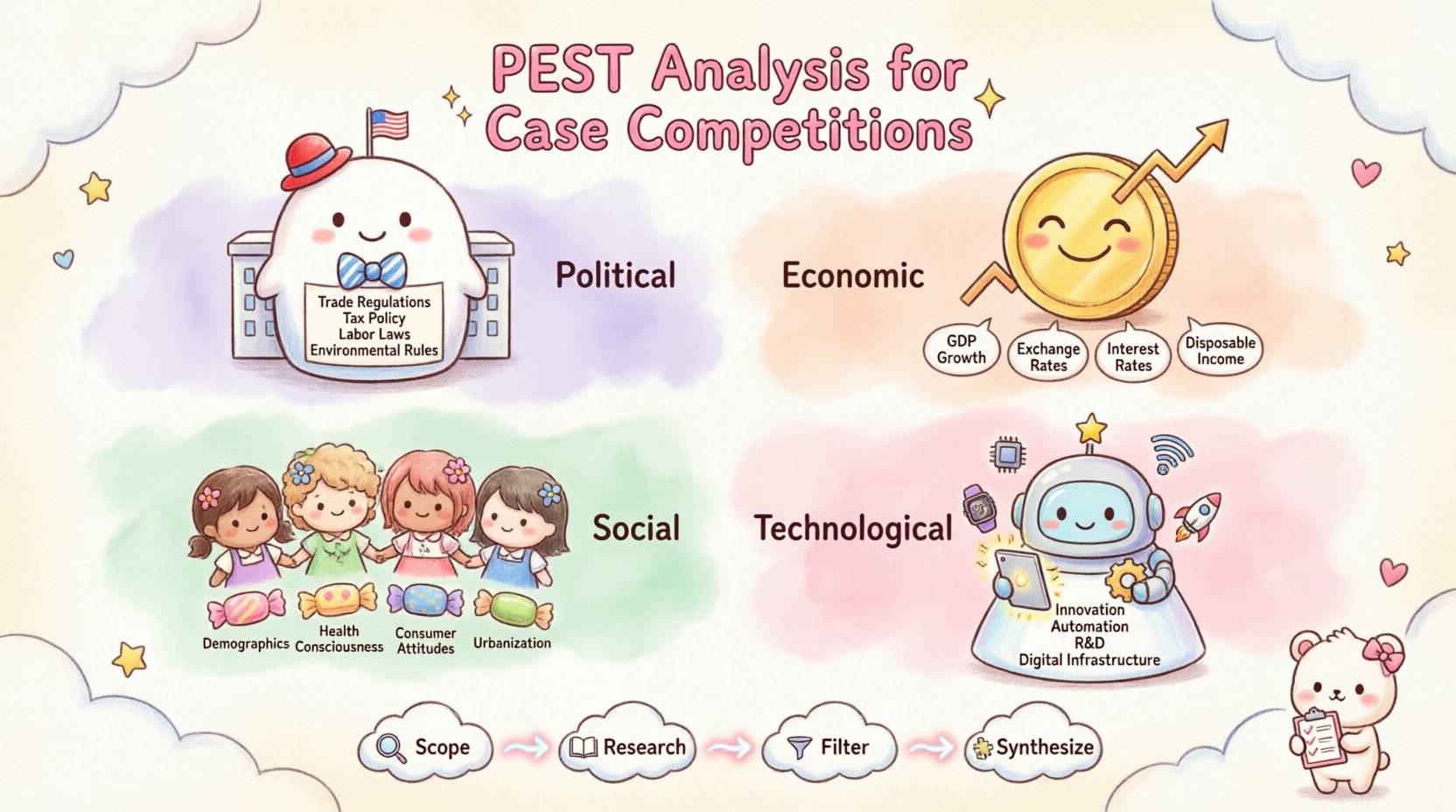
1. Political Factors (P)
Political factors refer to how government intervention affects the economy and industry. This is often the most volatile area. In a case study, you must identify regulations that could hinder or help the proposed solution.
- Trade Regulations: Tariffs, quotas, and trade barriers.
- Political Stability: Risk of unrest or policy shifts.
- Tax Policy: Corporate tax rates and incentives.
- Labor Laws: Minimum wage, union regulations, and hiring practices.
- Environmental Regulations: Compliance costs and sustainability mandates.
2. Economic Factors (E)
Economic factors determine the purchasing power of potential customers and the cost of capital. They dictate the financial viability of the business model.
- Economic Growth: GDP growth rates and inflation levels.
- Exchange Rates: Impact on import/export costs.
- Interest Rates: Cost of borrowing for expansion.
- Disposable Income: How much consumers can afford to spend.
- Cyclical Trends: Where the economy is in the business cycle (recession vs. expansion).
3. Social Factors (S)
Social factors encompass the demographic and cultural aspects of the target market. These trends often evolve slowly but have massive long-term impacts.
- Demographics: Age distribution, population growth, and migration patterns.
- Health Consciousness: Shifts in lifestyle and wellness priorities.
- Consumer Attitudes: Preferences for ethical sourcing or local production.
- Education Levels: Impact on workforce skills and consumer literacy.
- Urbanization: Shift from rural to city living affects logistics and demand.
4. Technological Factors (T)
Technological factors relate to innovation and how technology changes the way business is done. This is often the fastest-moving category.
- Innovation Rate: Speed at which new technologies replace old ones.
- Automation: Impact on labor costs and efficiency.
- Research & Development: Access to new patents or proprietary tech.
- Infrastructure: Internet penetration and logistics networks.
- Security: Data privacy laws and cybersecurity risks.
🚀 Step-by-Step Implementation
Applying this framework under pressure requires a systematic workflow. Follow these steps to ensure efficiency during the competition.
Step 1: Define the Scope
Before researching, define the boundaries. Is the case about a global expansion or a local startup? A global scope requires different data than a local one. Clarify the geography and industry immediately.
Step 2: Assign Research Roles
Divide the team. Assign one member to focus on Political and Economic data, while another handles Social and Technological trends. This parallel processing saves valuable time.
Step 3: Gather Data
Look for credible sources. Government reports, industry white papers, and academic journals are superior to general news articles. Prioritize recent data to ensure relevance.
Step 4: Filter for Impact
Not all factors are equal. A minor tax change might be noise. A new trade embargo is signal. Use a matrix to prioritize factors based on Impact and Probability.
Step 5: Synthesize Findings
Combine the data into actionable insights. How does the economic climate affect the social trend? How does technology enable a political solution? Connect the dots.
📋 Data Prioritization Matrix
Use a table to organize your findings. This helps in presenting a clear view to the judges.
| Factor | Impact (High/Low) | Probability (High/Low) | Strategic Implication |
|---|---|---|---|
| New Trade Tariffs | High | Medium | Re-evaluate supply chain costs |
| Aging Population | High | High | Shift product focus to seniors |
| AI Adoption | Medium | High | Invest in automation tools |
| Local Tourism Boom | Low | Low | Monitor, do not pivot yet |
⚠️ Common Pitfalls to Avoid
Even experienced teams make mistakes when applying this framework. Be aware of these common errors.
- Generalizations: Stating “the economy is growing” without citing specific rates or regions.
- Ignoring Interconnectivity: Treating the four factors as silos. They influence each other.
- Outdated Data: Using data from five years ago when the market has shifted.
- Focus on the Negative: PEST is not just about threats. It includes opportunities.
- Lack of Relevance: Including factors that do not apply to the specific case problem.
🔗 Integrating with Other Frameworks
PEST Analysis rarely stands alone. It sets the stage for deeper strategic tools. Here is how it fits with other models.
SWOT Analysis
PEST provides the “Opportunities” and “Threats” for a SWOT analysis. The internal strengths and weaknesses come from the company itself. PEST ensures the external analysis is robust.
Porter’s Five Forces
While Porter’s looks at industry rivalry, PEST looks at the macro environment. Use PEST to understand why industry rivalry is changing. For example, new technology might lower barriers to entry.
📝 Example Scenario Application
Consider a case where a beverage company wants to launch a new energy drink in Southeast Asia. Here is how the analysis would look.
Political
The region has varying sugar taxes. Some countries are introducing stricter labeling laws. The company must ensure compliance across all target markets to avoid fines.
Economic
Rising middle-class income in urban centers increases disposable income. However, currency volatility in some nations could affect pricing strategy for imports.
Social
There is a growing health consciousness. Consumers are shifting away from high-sugar drinks. The product must be positioned as a functional wellness aid rather than just a sugar rush.
Technological
Mobile payment adoption is high. The distribution channel must support QR code payments. Additionally, social media penetration is high, requiring a digital-first marketing approach.
💡 Tips for Presentation
How you present this analysis is just as important as the analysis itself.
- Visuals: Use charts to show economic trends. Avoid walls of text.
- Clarity: Summarize each factor in one sentence before expanding.
- Relevance: Explicitly state how each factor influences the recommendation.
- Confidence: Speak to the data. If you are unsure, acknowledge the uncertainty.
- Time Management: Do not spend 50% of the presentation on background. Keep it tight.
🔍 Deep Dive: Research Strategies
Where do you find the data without access to expensive databases? There are free and accessible sources.
- Government Websites: Bureau of Labor Statistics, Central Banks, and Trade Ministries.
- International Organizations: World Bank, IMF, and OECD reports.
- Industry Associations: Trade groups often publish market outlooks.
- News Archives: Use search filters to find historical trends.
- Academic Databases: Google Scholar for peer-reviewed insights.
When gathering data, look for the “Why” behind the numbers. A GDP drop is a number. A political scandal causing the drop is the context. Judges appreciate the context.
🛠️ Building the Strategy
Once the analysis is complete, translate it into strategy. This is the bridge between theory and practice.
- Adaptation: Modify the product to fit Social trends.
- Compliance: Adjust operations to meet Political regulations.
- Efficiency: Leverage Technological tools to cut Economic costs.
- Timing: Launch when Economic indicators are favorable.
This translation step is where many teams fail. They list the factors but do not explain how to act on them. Ensure every insight leads to a specific action.
🤝 Team Dynamics and Collaboration
Case competitions are team sports. PEST Analysis benefits from diverse perspectives.
- Debate the Factors: Have members challenge each other’s assumptions about the data.
- Cross-Check: Ensure the Economic data aligns with the Social data.
- Unified Voice: Present the findings as one coherent narrative, not four separate reports.
Conflict is natural. Use it to stress-test your logic. If a team member argues against a Political factor, find out why. It might reveal a blind spot.
📈 Measuring Success
How do you know your PEST Analysis was effective? Look at the feedback from judges.
- Did they ask about external risks? If yes, you likely covered it well.
- Did they question your assumptions? This means you were transparent about data sources.
- Was the strategy actionable? This means you successfully synthesized the data.
🌟 Final Thoughts
Mastering the PEST Analysis framework takes practice. It moves from a checklist to a lens through which you view the world. In a case competition, this lens provides clarity. It separates superficial ideas from viable strategies.
Remember that the goal is not to find every possible factor. The goal is to find the critical factors that drive the decision. Focus your energy there. Use the data to tell a story. Ensure the story leads to a logical conclusion.
By following this guide, you build a foundation of knowledge. You prepare yourself to handle complex scenarios with confidence. The external environment is constant. Your ability to analyze it is your competitive advantage.
Related posts:
 How to Execute a PEST Analysis for Your International Business Strategy: A Step-by-Step Walkthrough
 PEST Analysis vs. SWOT: A Direct Comparison for MBA Students to Avoid Common Pitfalls
 The 3-Step Quick Start Guide to Conducting a PEST Framework in Under an Hour
 Real-World Case Studies: How Top Firms Used PEST Analysis to Navigate Global Markets