


Strategic planning often begins with environmental scanning. Among the various frameworks available, the PEST analysis remains a staple for organizations seeking to understand the macro-environment. However, a common pitfall exists: teams frequently produce descriptive lists without deriving genuine strategic value. This document explores how to apply critical thinking to the PEST framework, transforming raw data into actionable intelligence.
The Trap of Descriptive PEST Analysis 📝
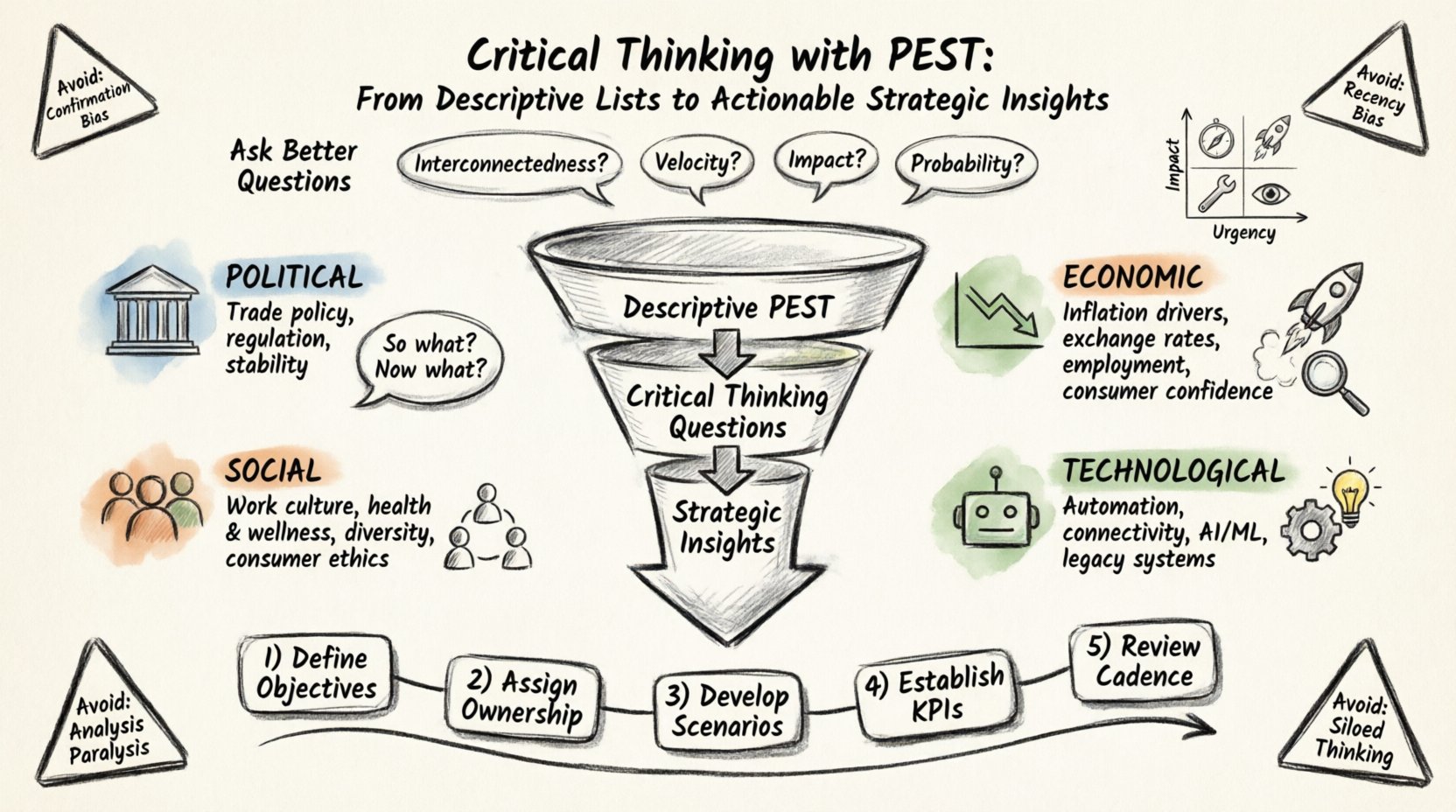
Most organizations treat PEST as a checkbox exercise. They list political changes, economic indicators, social shifts, and technological advancements. The output is often a static document that sits on a shelf.
- Descriptive Approach: “Interest rates are rising.” “New regulations are coming.” “Social media usage is up.”
- Strategic Approach: “Rising interest rates increase our cost of capital, requiring a shift in our financing strategy.” “New regulations create a compliance barrier for our current market entry plan.”
The difference lies in the application of critical thinking. A descriptive list tells you what is happening. A strategic insight explains so what and now what.
The Critical Thinking Shift: Asking Better Questions 🤔
To move from observation to strategy, you must interrogate the data. Critical thinking in this context means challenging assumptions and connecting disparate dots.
Key Questions for Strategic Depth
- Interconnectedness: How does a political decision impact economic stability?
- Velocity: How quickly is this trend accelerating?
- Impact: Is this a minor fluctuation or a structural shift?
- Probability: How likely is this scenario to occur within our planning horizon?
By asking these questions, you move from passive recording to active analysis.
Deep Dive: Political Factors (Beyond Headlines) 🏛️
Political factors often grab attention due to their volatility. However, strategic insight requires looking past the news cycle.
Standard vs. Strategic Analysis
| Factor | Descriptive Observation | Strategic Insight |
|---|---|---|
| Trade Policy | Tariffs increased on imports. | Supply chain costs will rise 15% in Q3; diversification of vendors in Southeast Asia is required immediately. |
| Regulation | Data privacy laws are tightening. | Current data infrastructure is non-compliant; budget allocation for security overhaul must increase by 20%. |
| Stability | Government election approaching. | Policy uncertainty suggests delaying capital expenditure until post-election clarity is established. |
Critical Thinking Prompts for Political Factors
- Does this policy favor incumbents or disruptors?
- What is the enforcement capability of this regulation?
- Are there regional variations in political stability?
- How does this align with our corporate governance standards?
Deep Dive: Economic Indicators (Beyond GDP) 📉
Economic data is often treated as a singular metric. Strategic thinking requires understanding the nuance behind the numbers.
Key Economic Dimensions
- Inflation: Not just the rate, but the drivers (supply vs. demand).
- Exchange Rates: Volatility impacts pricing power and margin protection.
- Employment: Labor scarcity drives wage inflation and operational costs.
- Consumer Confidence: A leading indicator of spending behavior.
Actionable Questions for Economic Factors
- If inflation remains above 5% for 12 months, how does this affect our pricing elasticity?
- Does a recessionary signal require a shift to value-tier products?
- How does currency fluctuation impact our international revenue streams?
- Are credit conditions tightening for our target customer segment?
Consider a scenario where inflation is high. A descriptive list notes this fact. A strategic insight asks: “Can we pass this cost to the customer without losing volume?” If the answer is no, the strategy must focus on cost reduction or value engineering.
Deep Dive: Social Trends (Beyond Demographics) 🧑🤝🧑
Social factors are often misunderstood as simple demographics. They are actually about values, behaviors, and cultural shifts.
Identifying Structural Shifts
- Work Culture: Remote work is not just a location change; it alters real estate strategy and talent acquisition.
- Health & Wellness: A shift toward preventative care changes product demand.
- Diversity & Inclusion: This is a compliance issue and a brand reputation driver.
- Consumer Ethics: Sustainability is now a purchase criterion, not a bonus.
Strategic Implications Table
| Trend | Descriptive View | Strategic Implication |
|---|---|---|
| Aging Population | Demographics show more seniors. | Product design must prioritize accessibility; marketing channels must shift from digital-first to hybrid. |
| Remote Work | More people work from home. | Commercial real estate holdings may become liabilities; invest in digital collaboration tools. |
| Sustainability | Customers care about the environment. | Supply chain transparency is a competitive advantage; greenwashing risks legal and reputational damage. |
Deep Dive: Technological Disruption (Beyond Gadgets) 🤖
Technology is not just about new tools; it is about how tools change business models.
Categorizing Technological Impact
- Automation: Reduces labor costs but changes workforce skill requirements.
- Connectivity: Increases data flow but raises cybersecurity risks.
- AI & Machine Learning: Enhances decision speed but introduces bias and ethical concerns.
- Legacy Systems: Obsolescence creates technical debt and integration barriers.
Questions for Technological Factors
- Is this technology a threat to our core revenue model?
- Can we acquire this capability internally or must we partner?
- What is the learning curve for our current workforce?
- How does this technology affect our customer experience lifecycle?
For instance, the rise of AI in customer service is not just about chatbots. It requires a rethink of human resource allocation. You might reduce support headcount but increase investment in training for complex issue resolution.
Synthesizing the Data: The Strategic Matrix 🧩
Collecting insights is only half the battle. Synthesizing them reveals the true picture. A matrix approach helps prioritize actions.
The Impact/Urgency Grid
Map your PEST findings onto a grid based on two axes:
- Impact: How much does this affect our bottom line?
- Urgency: How soon must we respond?
This categorization prevents resource dilution.
- High Impact / High Urgency: Immediate action required. Resource allocation must be prioritized here.
- High Impact / Low Urgency: Strategic planning phase. Develop scenarios and long-term roadmaps.
- Low Impact / High Urgency: Operational adjustments. Fix quickly to reduce noise.
- Low Impact / Low Urgency: Monitor. No immediate investment needed.
Connecting the Dots
Look for correlations between factors. A technological shift (e.g., AI) might be enabled by a political decision (e.g., data sovereignty laws). An economic downturn might accelerate social trends (e.g., frugality). These correlations are where the real strategy hides.
From Insight to Action: Implementation Steps 🚀
Insights without execution are merely trivia. Here is how to operationalize the critical thinking process.
Step 1: Define Strategic Objectives
Align the PEST analysis with organizational goals. If the goal is growth, focus on opportunities. If the goal is stability, focus on risks.
Step 2: Assign Ownership
Every insight must have an owner. If a political regulation affects compliance, the Legal Department owns the response. If economic data affects pricing, Finance owns the response.
Step 3: Develop Scenarios
- Best Case: What if the trend accelerates favorably?
- Worst Case: What if the trend accelerates negatively?
- Most Likely: What is the baseline expectation?
Step 4: Establish KPIs
Track the factors you identified. If you noted a regulatory risk, track the legislative progress. If you noted an economic trend, track the specific index monthly.
Step 5: Review Cadence
PEST is not a one-time event. Set a quarterly review cycle. Environmental factors change rapidly; your analysis must keep pace.
Monitoring and Iteration 🔄
The environment is dynamic. A strategy built on yesterday’s data is obsolete today. Continuous monitoring is essential.
- Early Warning Systems: Set up alerts for key indicators (e.g., interest rate changes, new legislation drafts).
- Feedback Loops: Did the strategy work? If not, why? Was the insight wrong, or was the execution flawed?
- External Validation: Do not rely solely on internal analysis. Engage with industry peers and external experts.
Common Pitfalls to Avoid ⚠️
Even with critical thinking, errors can occur. Be aware of these common traps.
- Confirmation Bias: Only looking for data that supports your pre-existing plan.
- Analysis Paralysis: Spending too much time analyzing and not enough time acting.
- Recency Bias: Over-weighting the most recent news event over long-term trends.
- Siloed Thinking: Treating P-E-S-T factors as separate when they are deeply interconnected.
Building a Culture of Strategic Thinking 🏗️
For PEST analysis to remain effective, the organization must value critical thinking. This requires training and mindset shifts.
- Encourage Debate: Allow teams to challenge the analysis findings.
- Document Assumptions: Make the underlying assumptions of the strategy explicit.
- Reward Insight: Recognize team members who identify risks or opportunities before competitors.
- Simplify Reporting: Ensure the output is digestible for decision-makers. Avoid jargon.
Final Thoughts on Strategic Clarity 🎯
The value of PEST analysis is not in the categorization of factors. It is in the clarity of action that follows. By applying critical thinking, you transform a static list into a dynamic roadmap. You stop asking what is happening and start asking how to shape the outcome.
This approach requires discipline. It demands that you question the data, connect the dots, and commit to execution. When done correctly, it provides a robust foundation for navigating an uncertain future. The goal is not to predict the future perfectly, but to be prepared for multiple futures.
Start by auditing your current PEST process. Identify where it remains descriptive. Introduce the questions outlined here. Assign ownership to the insights. Monitor the results. This iterative process builds organizational resilience and ensures that strategic decisions are grounded in reality, not just hope.
Related posts:
 How to Execute a PEST Analysis for Your International Business Strategy: A Step-by-Step Walkthrough
 PEST Analysis vs. SWOT: A Direct Comparison for MBA Students to Avoid Common Pitfalls
 The 3-Step Quick Start Guide to Conducting a PEST Framework in Under an Hour
 Real-World Case Studies: How Top Firms Used PEST Analysis to Navigate Global Markets