


Model-Based Systems Engineering (MBSE) has transformed how complex systems are designed, verified, and validated. Instead of relying solely on documents, engineers now leverage executable models to capture system behavior, structure, and requirements. However, the transition from document-centric to model-centric workflows introduces a steep learning curve. For early career engineers, the path to proficiency is often paved with avoidable pitfalls.
Systems Modeling Language (SysML) is the standard for this approach. It extends Unified Modeling Language (UML) to handle the specific needs of systems engineering. Yet, even with powerful capabilities, incorrect modeling practices can lead to bloated diagrams, untraceable requirements, and models that cannot be simulated or analyzed effectively. This guide outlines the top five errors that frequently stall development progress and provides the corrective strategies needed to build robust, maintainable models.
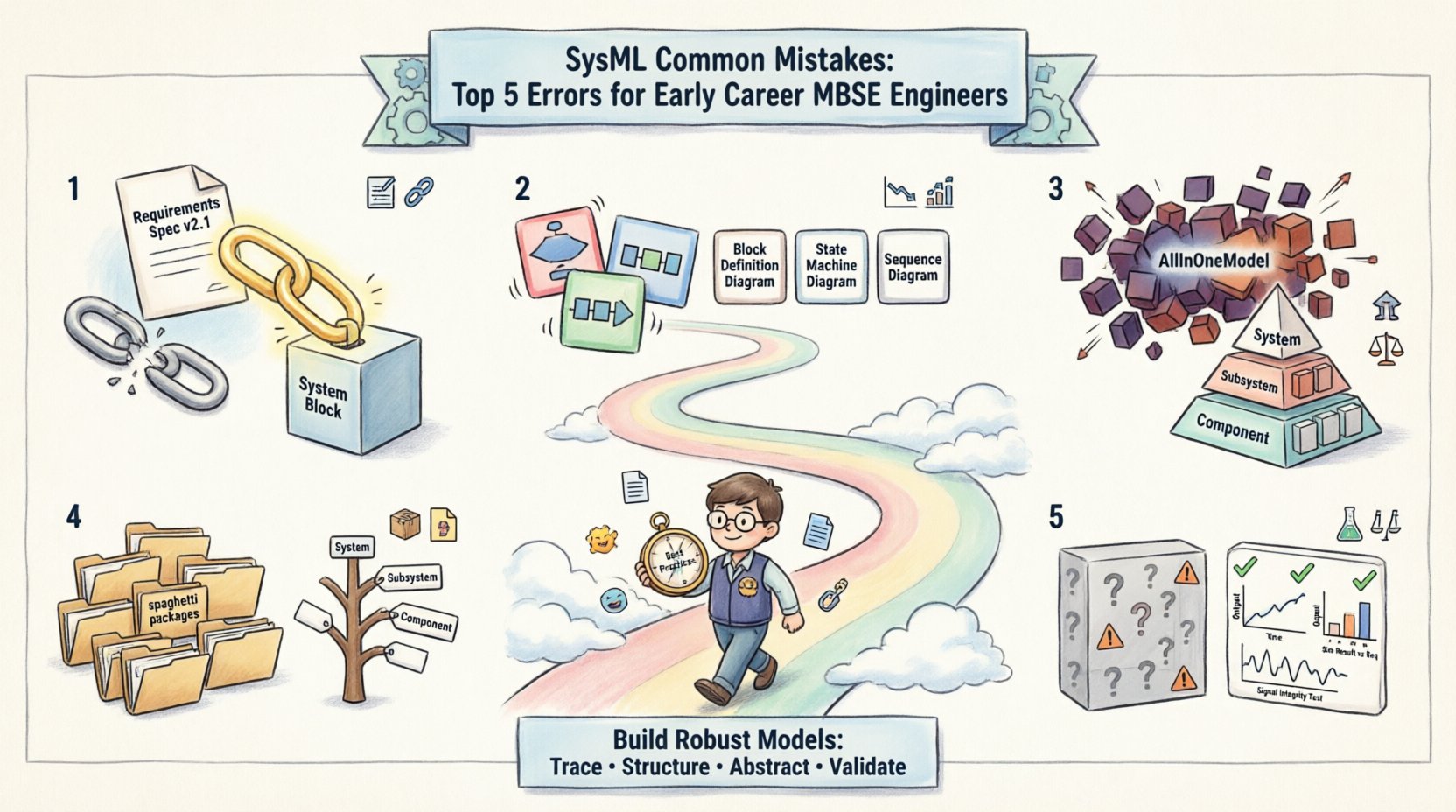
1. Neglecting Requirements Traceability 📋🔗
One of the primary motivations for adopting MBSE is the ability to link requirements directly to the design. When this link is broken, the model loses its value as a source of truth. Early career engineers often create a model that looks visually appealing but fails to demonstrate how the design satisfies the stakeholder needs.
The Problem:
- Creating requirements in one package and the design in another without explicit links.
- Using free-text comments instead of formal requirement diagrams.
- Assuming that a diagram implies a requirement is met without a formal link.
The Impact:
Without traceability, impact analysis becomes a manual nightmare. If a requirement changes, the engineer cannot quickly identify which blocks or components are affected. This leads to regression errors and rework later in the project lifecycle. Furthermore, verification activities become difficult because there is no automated way to check if a requirement is satisfied by the model.
The Correction:
Establish a strict workflow where every requirement in a Requirements Diagram is linked to at least one design element. Use the refine relationship to connect requirements to blocks. Use the satisfy relationship to show how a block satisfies a requirement. Ensure that every internal block diagram (IBD) and use case map back to the overarching requirements.
2. Misusing Diagram Types and Syntax 📉📊
SysML provides nine distinct diagram types, each serving a specific purpose. A common error is forcing a modeling problem into the wrong diagram type, resulting in confusion and information loss. Early career engineers often default to Block Definition Diagrams (BDD) for everything, ignoring the specialized capabilities of other diagrams.
Common Confusions:
- Using BDD for behavior: BDDs define static structure. Using them to show state transitions or flow of control is confusing and violates the language semantics.
- Using Use Case Diagrams for internal logic: Use Cases describe external interactions. They should not be used to define internal operational sequences.
- Neglecting Parametric Diagrams: These are essential for constraint analysis. Skipping them means missing opportunities to verify performance and physical properties.
The Correction:
Adhere to the specific intent of each diagram type:
- BDD: Define structure, types, and relationships (composition, generalization).
- Internal Block Diagram (IBD): Define internal connections, ports, and flow items.
- Sequence Diagram: Define temporal interactions between parts.
- State Machine Diagram: Define the lifecycle and conditions of a part.
- Parametric Diagram: Define mathematical constraints and dependencies.
By aligning the diagram type with the specific engineering question, the model remains readable and semantically correct.
3. Over-Modeling and Lack of Abstraction 🏗️📦
In the pursuit of completeness, engineers often model every single detail from the start. This leads to massive, unmanageable models that are difficult to navigate. This is often referred to as “boiling the ocean.” While detail is necessary, it must be introduced at the right time.
The Problem:
- Defining internal connections for every block immediately without understanding the high-level architecture.
- Creating detailed state machines before the functional flow is defined.
- Modeling specific parameters before the system requirements are locked.
The Impact:
When a model is too detailed too soon, it becomes brittle. Changing a high-level concept requires refactoring dozens of low-level elements. This slows down iteration and discourages exploration of alternative architectures. It also makes it hard for stakeholders to understand the system, as they are drowned in technical details.
The Correction:
Adopt a top-down approach. Start with the system context and high-level blocks. Leave internal details open or abstract until the architecture is stable. Use stereotyping or abstract blocks to represent components that are not yet fully defined. This allows for rapid iteration on the architecture before diving into the specifics of implementation.
4. Ignoring Package Structure and Namespace Management 🗂️🚫
As models grow, they become collections of many diagrams and elements. Without a logical package structure, the model becomes a “spaghetti code” equivalent of systems engineering. Elements are scattered, references break, and navigation becomes a hunt-and-peck exercise.
Common Mistakes:
- Placing all elements in the default root package.
- Creating packages based on diagrams rather than system functions or subsystems.
- Using ambiguous element names without clear namespace prefixes.
The Impact:
When the package structure is poor, importing or exporting models becomes error-prone. Linking elements across packages becomes difficult. Version control for models becomes chaotic because multiple engineers might edit the same root package simultaneously. It also hinders reuse, as finding a specific subsystem definition is nearly impossible.
The Correction:
Design the package structure based on the system decomposition, not the document hierarchy. Use a logical hierarchy that mirrors the physical or functional breakdown of the system. For example:
SystemSubsystem_AComponent_1Component_2Subsystem_B
Use well-defined prefixes for packages and elements to ensure uniqueness. Regularly review the package structure during design reviews to ensure it aligns with the evolving system architecture.
5. Failure to Validate Constraints and Logic ⚖️🧪
A model is only as good as its ability to simulate reality. Many engineers treat SysML as a drawing tool rather than a simulation environment. They create diagrams but never test the logic, constraints, or flows defined within them.
The Problem:
- Creating parametric constraints without verifying their solvability.
- Writing state machine logic that has dead ends or unreachable states.
- Ignoring the validation of flow items and data types.
The Impact:
When the model is never validated, it provides a false sense of security. A design might look correct on a diagram but fail immediately when subjected to simulation or analysis. This leads to discoveries of critical flaws late in the development cycle, which are expensive to fix. It also undermines the credibility of the MBSE process with stakeholders.
The Correction:
Integrate validation into the daily workflow. Run simulations on state machines to ensure all paths are reachable. Solve parametric constraints to verify that performance requirements are met. Use the model to generate test cases. If the model cannot be executed or analyzed, it is not a true system model; it is just a diagram.
Comparison of Common Errors vs Best Practices ⚖️
To summarize the distinctions between ineffective modeling and effective engineering, consider the following comparison table:
| Common Error | Consequence | Best Practice |
|---|---|---|
| Ignoring Requirements Traceability | Impact analysis is manual and error-prone | Link every requirement to design elements using refine and satisfy |
| Misusing Diagram Types | Confusion and loss of semantic meaning | Use specific diagrams for specific questions (e.g., Parametric for math) |
| Over-Modeling Early | Brittle models, slow iteration | Start with high-level abstraction, refine later |
| Poor Package Structure | Hard to navigate, version conflicts | Structure packages by system decomposition, not diagrams |
| Skipping Validation | False confidence, late discovery of flaws | Simulate logic and solve constraints regularly |
Building a Sustainable Modeling Culture 🌱🤝
Addressing these errors is not just about fixing technical details; it is about fostering a culture of quality. Early career engineers should be encouraged to ask questions about the model’s purpose rather than just its appearance. Mentorship is crucial in this transition. Senior engineers should review models not just for syntax, but for semantic integrity.
Key Strategies for Teams:
- Standardization: Create a modeling standard that defines naming conventions, package structures, and diagram usage rules.
- Automation: Use scripts or tool capabilities to check for traceability gaps or circular dependencies.
- Training: Invest in formal training on SysML semantics, not just tool buttons.
- Reviews: Conduct regular model reviews where the logic is walked through, not just the diagrams.
The Long-Term Value of Correct Modeling 📈💡
Correcting these common mistakes requires upfront effort. It takes longer to structure packages correctly or to link requirements explicitly. However, the long-term return on investment is significant. A well-structured model pays dividends in reduced rework, clearer communication, and faster verification.
When models are built on solid foundations, they become living artifacts that drive the system through its entire lifecycle. They support change management, enabling engineers to see the ripple effects of modifications instantly. They enable analysis, ensuring that the system will perform as intended before physical prototypes are built.
For the early career MBSE engineer, avoiding these pitfalls is the difference between building a document that sits on a shelf and building a digital twin that drives decision-making. The learning curve is steep, but the destination is a more efficient, reliable, and robust engineering process.
Remember that SysML is a language of communication as much as it is a language of logic. Clarity is the ultimate goal. By prioritizing traceability, semantic correctness, structural organization, and validation, engineers can ensure their models remain valuable assets throughout the project life cycle.
Final Thoughts on Model Maturity 🎓🏁
Maturity in systems modeling is not achieved overnight. It is a progression from drawing boxes to defining logic, and finally to simulating behavior. Each of the five errors discussed represents a stage where many projects stall. Recognizing these traps allows engineers to navigate around them and continue advancing.
The journey from novice to expert in MBSE involves constant refinement. Keep the model lean. Keep the traceability tight. Keep the structure logical. And always, always validate the logic. By adhering to these principles, the model becomes a powerful engine for innovation rather than a burden of documentation.
As you continue your work, refer back to these guidelines whenever a model feels unwieldy or unclear. They are designed to help you cut through the complexity and focus on what matters: the system itself. With discipline and attention to these common pitfalls, you will build models that stand the test of time and change.