
Mastering UML Sequence Diagrams: A Deep Dive into Lifelines and Object Identification
In the realm of software engineering, the UML (Unified Modeling Language) Sequence Diagram is one of the most powerful tools for visualizing the dynamic behavior of a system. It allows developers to map out the chronological order of interactions between different parts of an application. Central to this diagramming technique are lifelines, which serve as the visual representation of the participants involved in the interaction.
What is a Lifeline?
A lifeline is a fundamental element in a sequence diagram. It represents a specific participant in the system, such as an object, a class, an actor, or a component. You can think of a lifeline as the “timeline” of that specific entity. It tracks the life of the participant from the moment it is created until it is destroyed, or simply until the interaction concludes.
Visually, a lifeline is depicted as a vertical dashed line extending downward from a rectangular box. The vertical axis of the diagram represents time, flowing strictly from top to bottom. This means that messages and events appearing lower on the diagram occurred later in the sequence.
Decoding the Participant Box
At the top of every lifeline is a rectangular box. This box provides the identity of the participant. The content of this box can vary depending on the level of detail you wish to convey:
- Actor Name: Representing a user or an external system.
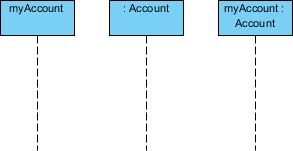
- Class Name: Representing a generic class type (e.g.,
Account). - Instance Name: Representing a specific object instance (e.g.,
myAccount). - Instance Declaration: A combination of both (e.g.,
myAccount : Account).
Interpreting the Diagram Syntax
When you look at a sequence diagram, the text inside the box at the top of the lifeline tells you exactly what kind of participant you are dealing with. Let’s analyze the specific syntax rules often seen in diagrams, such as those generated by Visual Paradigm.
Consider the following standard formats found in the diagram below:
- Instance Name Only:
myAccount. This indicates a specific instance of an object. - Class Name Only:
:Account. The colon prefix usually indicates the class name, and the lack of a specific name implies a generic representation of that class. - Full Declaration:
myAccount : Account. This is the most descriptive format, explicitly stating that the object namedmyAccountis an instance of theAccountclass.
The dashed line extending downwards from these boxes is the lifeline itself. In a real system, the width of the box at the top represents the object’s identity, while the dashed line represents its existence over time. If the line extends to the bottom of the diagram, it implies the object remains active throughout the entire interaction.
Visual Paradigm: The Tool for the Job
Creating precise and readable UML diagrams requires robust software. Visual Paradigm is widely recognized as a premier tool for this purpose. It supports the creation of complex sequence diagrams with ease, allowing users to define lifelines, add messages, and manage object instances visually.
By utilizing Visual Paradigm, you can ensure that your diagrams adhere to strict UML standards. The tool automatically handles the rendering of dashed lines and the formatting of participant boxes, ensuring that your documentation is professional and easy to understand for stakeholders.
Why Lifelines Matter
Understanding lifelines is crucial for debugging and architectural planning. When a developer reads a sequence diagram, they look at the lifelines to see which objects are “alive” and active during a specific operation. If a lifeline is missing or the interaction flow seems disjointed, it might indicate a logic error in the system design.
By mastering the creation and interpretation of lifelines, you gain the ability to communicate complex system behaviors clearly. Whether you are designing a new feature or refactoring legacy code, a well-structured sequence diagram with clear lifelines is an invaluable asset.