Modern software engineering and product development face a silent productivity tax: extreme tool fragmentation. On any given project, system architecture diagrams reside in one canvas tool, developer-authored plantUML files sit in Git repositories, product roadmaps live in separate web boards, and executive briefs exist as static PDFs.
Engineering and product leaders spend up to 20% of their working hours simply hunting down where an asset lives, reconciling outdated versions, or manually copy-pasting specifications between disconnected systems.
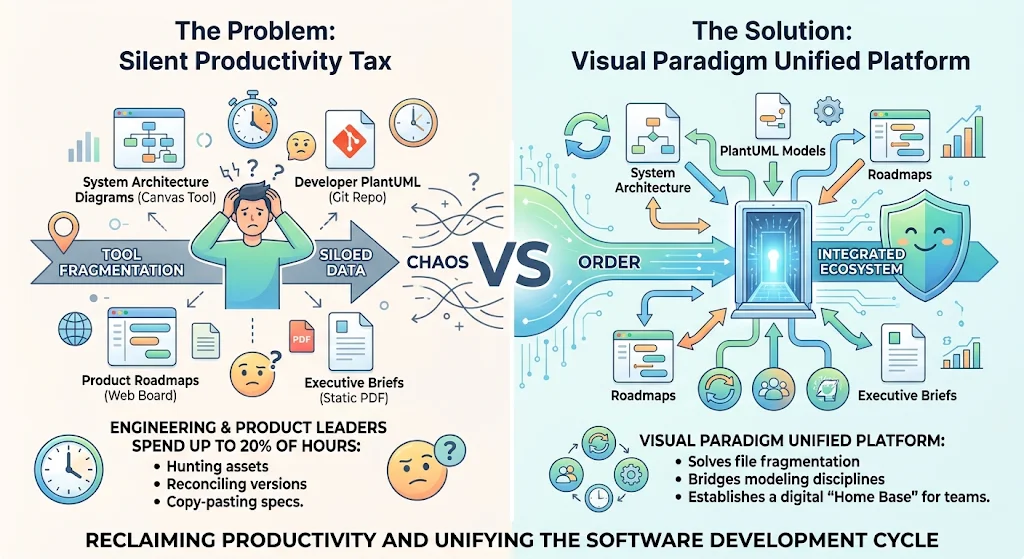
The Visual Paradigm Unified Platform addresses this challenge by serving as an integrated ecosystem designed to solve file fragmentation, bridge distinct modeling disciplines, and establish a digital “Home Base” for technical teams.
1. The Operational Angle: Eliminating Tool Sprawl and Context-Switching Friction
When visual specifications and enterprise models live in isolated silos, team velocity drops. A change made to a user journey in a light sketching tool rarely propagates to the formal UML or ArchiMate model managed by enterprise architects, leading to drift between high-level strategy and actual system implementation.
The Unified Platform acts as a central operational hub that eliminates navigation fatigue and context switching:
-
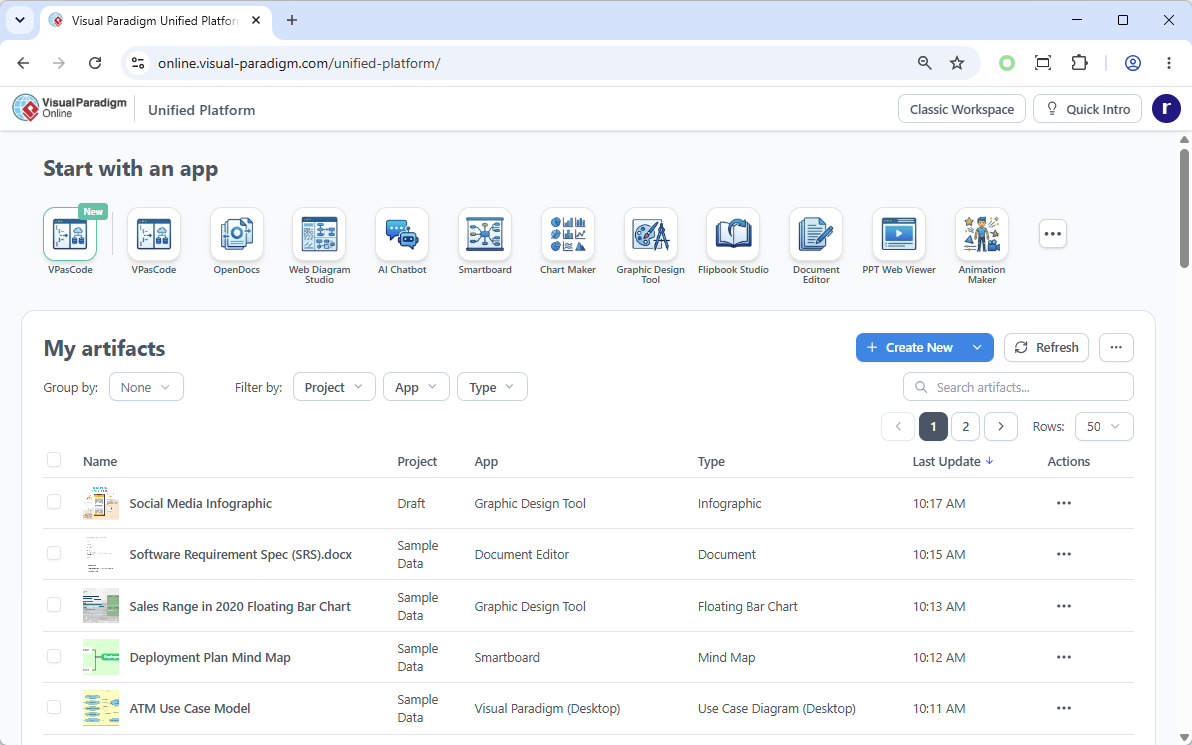
Centralized Discovery: Provides a single, categorized launcher for over 100 specialized Visual Paradigm web tools, planning frameworks, and AI studios, replacing bookmarked micro-apps with a structured directory.
-
Unified Artifact Management: Unifies local
.vppdesktop models, cloud-saved web diagrams, strategy canvases, and OpenDocs knowledge bases into a searchable repository. -
Cohesive Workspace: By replacing fragmented software stacks with a single entry point, teams maintain a single source of truth for both light browser-based modeling and deep desktop engineering.
2. The Architectural Paradigm Shift: Bridging “Diagram-as-Code” and Visual Modeling
A long-standing divide exists between developers and system architects:
-
Developers favor text-driven, version-controlled workflows using declarative tools like PlantUML, Mermaid.js, Graphviz DOT, D2, and SysML v2.
-
Enterprise Architects & Product Managers require rich visual drag-and-drop modeling environments for complex standards like TOGAF, BPMN, and ArchiMate.
Rather than forcing teams to choose one methodology, the Unified Platform establishes a bi-directional workflow between text-based specifications and formal visual models.
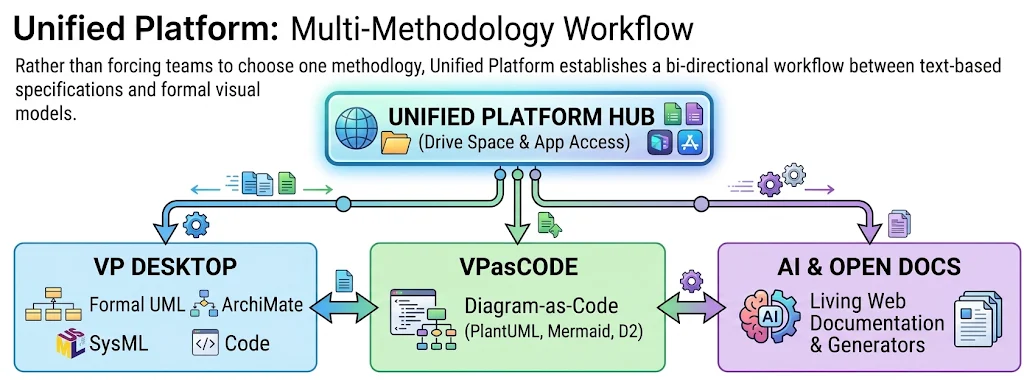
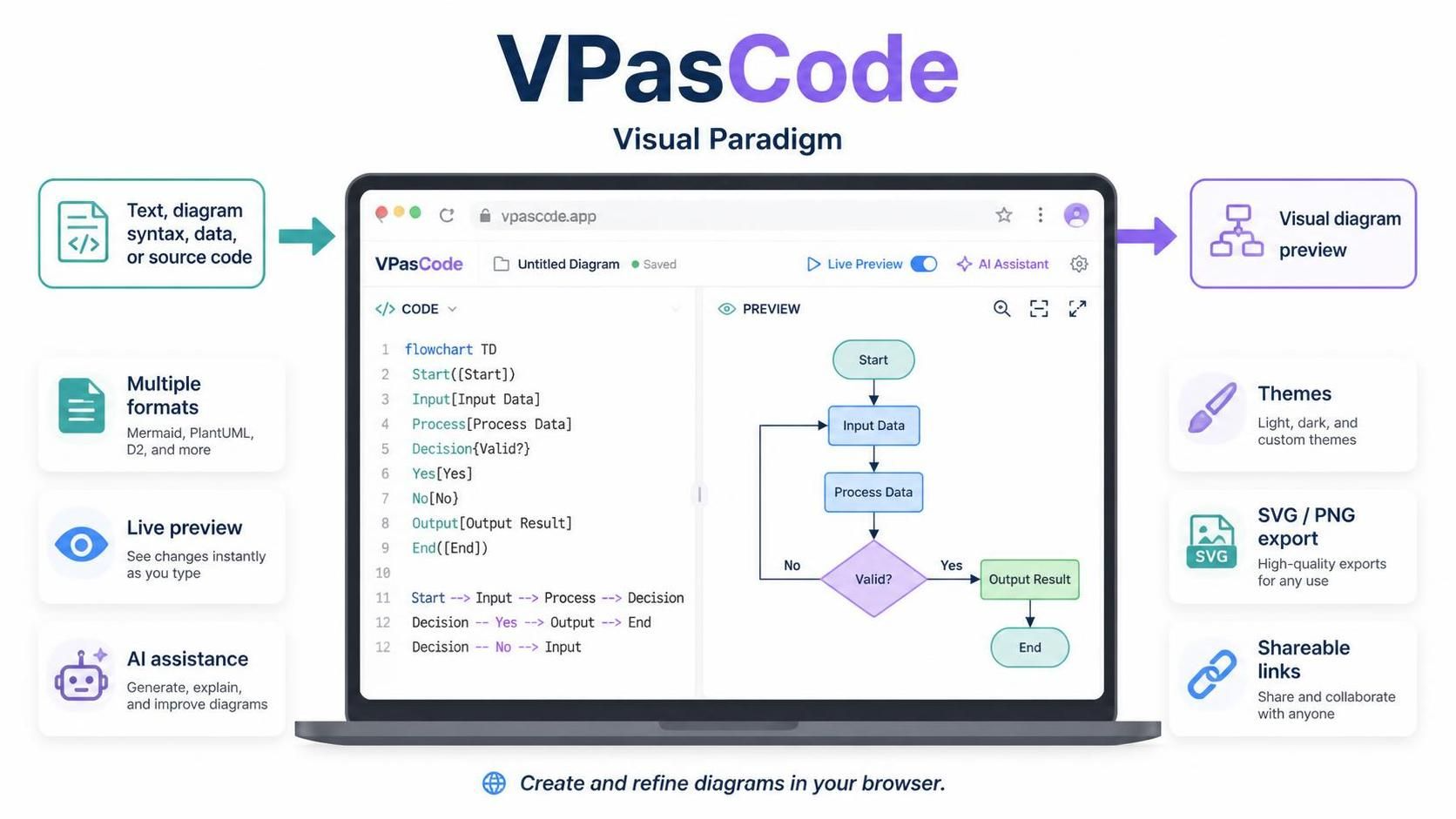
Through VPasCode, developers write declarative diagram source text directly into codebases or cloud repositories. Concurrently, architects and product leaders can open, refine, and incorporate those exact structures inside Visual Paradigm Desktop or web canvases. Artifacts sync effortlessly across both browser light-modeling tools and heavy desktop engineering environments, ensuring developer-authored code and enterprise blueprints remain aligned.
3. Knowledge Management: From Static Schemas to Living Artifacts
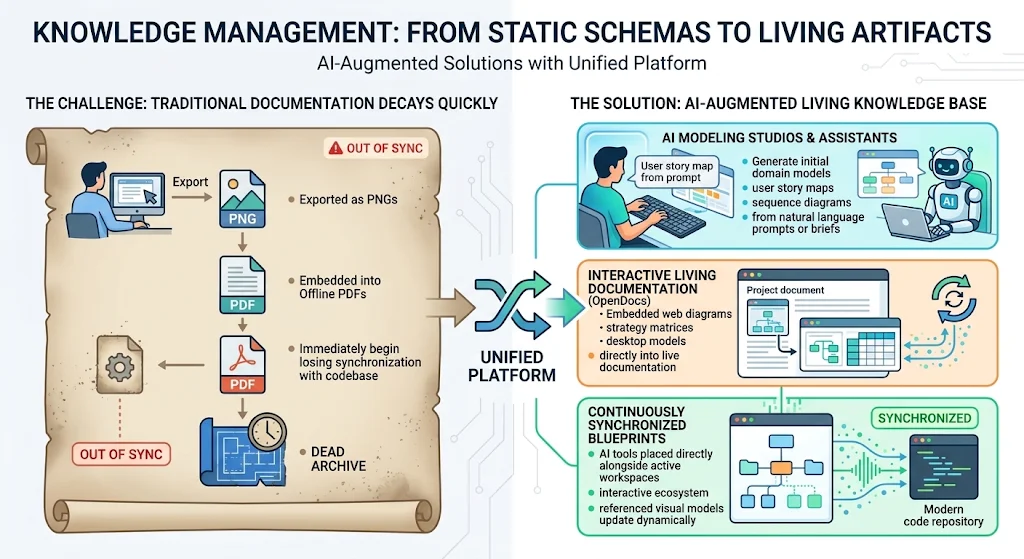
Traditional documentation decays quickly. When system architectures are exported as static PNGs or embedded into offline PDFs, they immediately begin losing synchronization with the underlying codebase.
The Unified Platform transforms static schemas into an AI-augmented living knowledge base:
-
AI Modeling Studios & Assistants: Integrated AI engines allow teams to generate initial domain models, user story maps, and sequence diagrams directly from natural language prompts or software requirement briefs.
-
Interactive Living Documentation (OpenDocs): Web diagrams, strategy matrices, and desktop models can be embedded directly into live documentation. As system specs evolve, referenced visual models update dynamically.
-
Continuously Synchronized Blueprints: By placing AI tools directly alongside active project workspaces, system documentation functions as an interactive ecosystem rather than a dead archive.
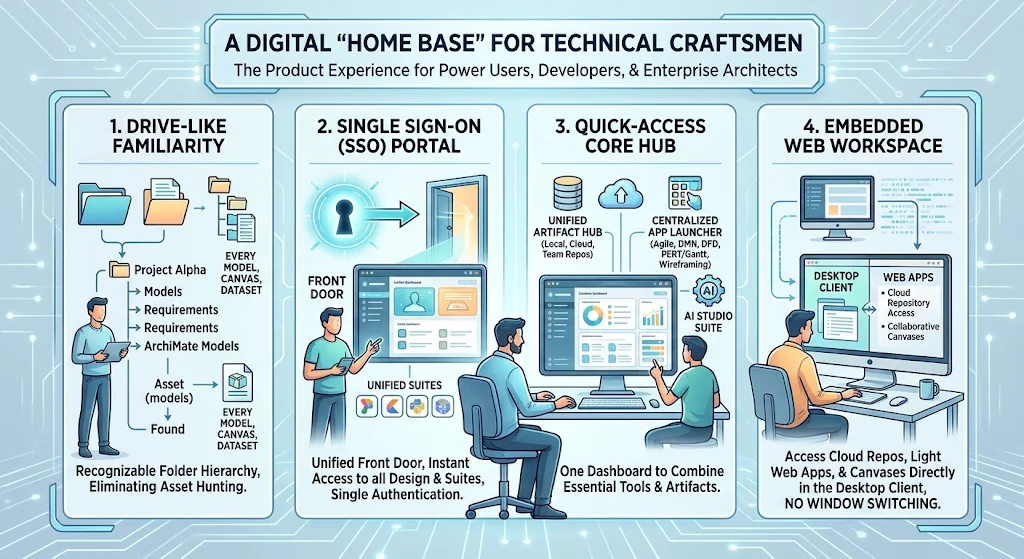
4. The Product Experience: A Digital “Home Base” for Technical Craftsmen
Power users, developers, and enterprise architects require workspace continuity similar to a dedicated IDE. The Unified Platform delivers this environment through four foundational pillars:
-
Drive-Like Familiarity: Organizes every model, canvas, dataset, and document into a recognizable folder hierarchy, eliminating asset hunting.
-
Single Sign-On (SSO) Portal: A unified front door that grants instant access to all connected design and strategy suites with a single authentication step.
-
Quick-Access Core Hub: Combines the Unified Artifact Hub (local, cloud, and team repos), the Centralized App Launcher (Agile, DMN, DFD, PERT/Gantt, and Wireframing tools), and the AI Studio Suite into one dashboard.
-
Embedded Web Workspace: Desktop power users can access cloud repositories, light web applications, and collaborative canvases directly from within the desktop client without switching windows.
Conclusion
By addressing the operational cost of tool sprawl, uniting Diagram-as-Code with visual modeling, powering living documentation via AI, and delivering a unified digital home base, the Visual Paradigm Unified Platform transforms visual modeling from a fragmented task into a streamlined, enterprise-grade engineering discipline.