


As enterprise architecture (EA) evolves into a strategic, data-rich discipline, the integration of artificial intelligence into modeling workflows has become a pivotal shift. In this year, 2026, Visual Paradigm stands at the forefront of this transformation—offering a certified, standards-compliant, and AI-enhanced platform specifically tailored for practitioners working within the TOGAF (The Open Group Architecture Framework) and ArchiMate 3.2 ecosystems.
Why Visual Paradigm? A Certified Platform for Enterprise Architecture
Visual Paradigm is not merely a modeling tool; it is a certified enterprise architecture environment by The Open Group, validating its adherence to the formal standards of TOGAF and the structural rigor of ArchiMate. This certification ensures that all artifacts—diagrams, views, viewpoints, and documentation—maintain the integrity and precision required by regulated industries such as finance, healthcare, government, and insurance.
 What sets Visual Paradigm apart in 2026 is its deep integration ofgenerative AI directly into the modeling lifecycle. Unlike generic AI tools that produce hallucinated or syntactically invalid outputs, Visual Paradigm’s AI engine is trained on authoritative sources including the official TOGAF 9.2 and ArchiMate 3.1/3.2 specifications. This ensures that every generated diagram, viewpoint, or analysis adheres to recognized industry semantics, avoiding common pitfalls like incorrect element relationships, invalid notation, or misaligned business-IT alignment.
Core AI Capabilities for TOGAF and ArchiMate
The platform’s AI features are not isolated functions—they form a cohesive, intelligent workflow that supports each phase of the Architecture Development Method (ADM), enabling architects to move from abstract ideas to compliant, production-ready deliverables with unprecedented speed and accuracy.

1. AI-Powered ArchiMate Diagram and Viewpoint Generator
This flagship feature allows users to generate fully compliant ArchiMate diagrams from natural language inputs, eliminating the need for manual element creation or rule-based modeling.
- Supports all 26 official ArchiMate viewpoints, including Layered, Motivation, Implementation & Migration, Capability, and Stakeholder.
- Processes complex prompts such as: “Generate a layered viewpoint for a cloud migration initiative involving business processes, applications, and technology infrastructure, with a focus on data flow and security.”
- Produces multi-layered, semantically correct models with proper element types (e.g.,
Application,Technology,Business Function) and valid relationships (e.g.,ASSOCIATES,DEPENDS ON,USE CASE). - Outputs are immediately valid for review, and users can refine them in the desktop editor without losing contextual integrity.
Real-world application: A digital transformation team at a large bank uses this feature to rapidly prototype a new AI-driven customer service architecture. Starting with “A centralized service layer for handling customer inquiries via chat and voice,” the AI generates a structured view that includes service layers, integration points, and business drivers—ready for refinement in the full desktop environment.
2. Intelligent Modeling Chatbot (AI Chatbot)
Embedded in both the cloud-based VP Online and desktop environments, the AI Chatbot functions as a real-time modeling partner. It enables conversational modeling—where users describe changes or additions in plain language, and the system interprets and executes them contextually.
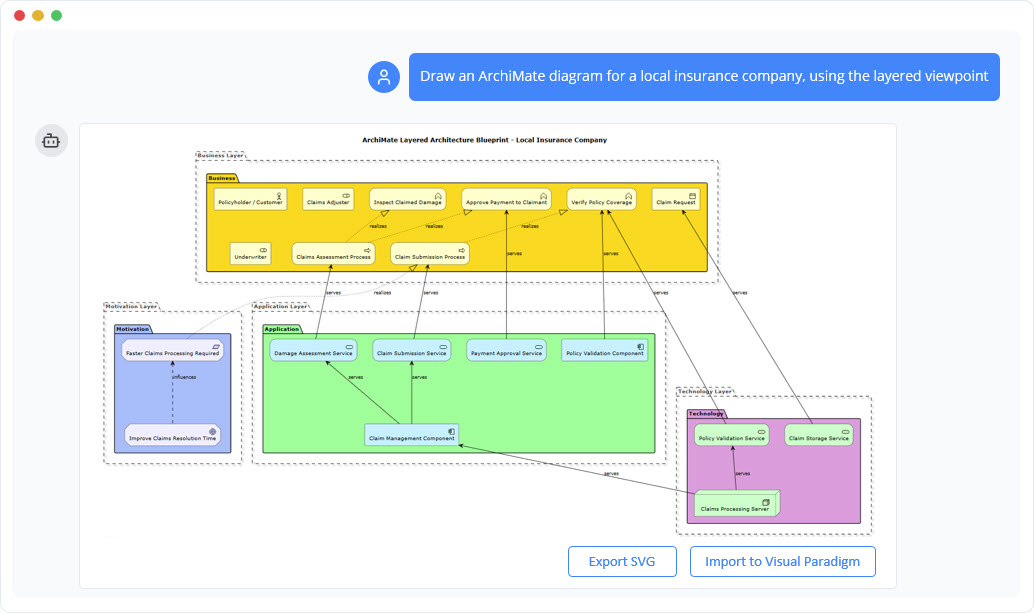
- Users can ask: “Add a reporting service in the application layer and connect it to the data warehouse.”
- It maintains semantic awareness—checking for consistency in naming, logical connections, and layout.
- Supports multiple modeling languages: ArchiMate, UML, SysML, C4, and beyond.
- Features a lossless round-trip mechanism: drafts created in the chatbot are exported in a robust JSON schema, preserving model structure, metadata, and relationships—making them fully compatible with desktop-level editing and certification.
This capability reduces the cognitive load of modeling, especially for cross-functional teams. For instance, a business analyst can describe a new compliance requirement in natural language, and the AI automatically updates relevant views and elements within the existing model.
3. AI-Powered Gap Analysis and Transition Planning
During TOGAF Phases B, C, and D—where architects analyze business and IT baselines and define transition paths—the AI performs automated gap detection and scenario planning.
- Users input baseline and target states (e.g., current system vs. cloud-migrated state).
- The AI detects missing elements, inconsistencies, and capability gaps (e.g., absence of data governance, lack of API integrations).
- Generates actionable artifacts: migration roadmaps, work packages, and phased transition architectures.
- These outputs serve as input for executive presentations and project planning.
Example: In a government agency’s digital service modernization, the AI identifies that the current system lacks identity management and fails to meet new GDPR compliance criteria. It then proposes a phased migration path with clear work packages, data governance controls, and timeline estimates.
4. Automated Visuals for Phase A (Architecture Vision)
At the outset of any EA initiative, Phase A (Architecture Vision) requires high-level strategic artifacts. Visual Paradigm’s AI can generate these instantly from textual inputs.
- Stakeholder mapping (identifying key players and their interests).
- Maturity assessment models (e.g., radar charts evaluating business, IT, and architecture capabilities).
- SWOT, PESTLE, or risk-integration matrices tailored to the domain.
These visuals are not just aesthetic—they are grounded in strategic analysis. For instance, a healthcare provider entering a digital health initiative can input “A strategy to improve patient care through digital record access” and receive a comprehensive stakeholder map and maturity assessment report with clear action points.
The AI-Powered TOGAF Guide-Through: A Step-by-Step Navigation Experience
One of the most innovative features is the AI-Powered TOGAFGuide-Through, which provides an interactive, phase-by-phase walkthrough of the ADM.
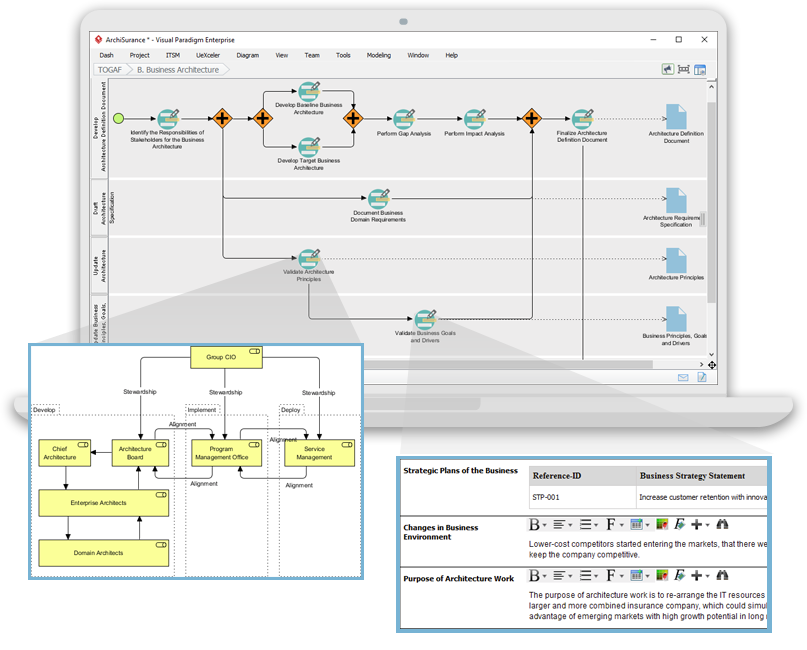
- Each phase triggers AI-driven artifact generation based on the project context.
- For example, in Phase A, the system generates a vision statement, stakeholder map, and business case.
- In Phase B, it suggests stakeholder analysis and capability mapping.
- The AI adapts to user input, refining outputs as the project evolves.
This eliminates the “blank canvas syndrome”—the challenge of starting an architecture project without clear direction. The guided workflow ensures compliance with TOGAF’s structured approach while enabling rapid iteration and stakeholder alignment.
Why This Matters: The Shift from Manual to Conversational Engineering
Traditional EA tools require significant time and expertise to produce compliant diagrams. With Visual Paradigm, the workflow transforms from manual, rule-based modeling to conversational, context-aware engineering.
Key differences:
| Traditional Approach | Visual Paradigm AI Approach |
|---|---|
| Manual diagram creation; time-consuming; error-prone | Conversational generation; contextual awareness; rapid prototyping |
| Requires deep familiarity with ArchiMate/TOGAF syntax | Uses natural language; intuitive for non-technical stakeholders |
| Limited feedback loops | Real-time model validation and refinement |
| Often leads to compliance gaps | Guaranteed adherence to standards through AI enforcement |
Strengths, Limitations, and Best Practices
Strengths
- Standards Compliance: Every AI-generated model is validated against ArchiMate 3.2 and TOGAF 9.2.
- Productivity Gains: Users report up to 80–90% faster artifact creation, especially during early-phase ideation.
- Contextual Intelligence: The AI tracks model state, dependencies, and narrative context—ensuring consistency across revisions.
- Seamless Workflow Integration: Cloud AI enables quick ideation; desktop editing ensures final deliverables meet certification standards.
- Business-IT Alignment: AI naturally maps business drivers to technical implementations (e.g., linking compliance to security controls).
Considerations and Limitations
- Only available in the Enterprise Edition of Visual Paradigm (Desktop or Online); basic editions lack AI and full ArchiMate support.
- AI outputs are strong starting points—but complex, organization-specific decisions (e.g., regulatory nuance, geopolitical risk) require expert oversight.
- Best suited for experienced EA practitioners or teams already familiar with visual modeling; beginners may require training to fully leverage the AI features.
- The model requires a clear initial input. Vague or ambiguous prompts may yield suboptimal outputs.
Target Use Cases and Industry Applications
Visual Paradigm’s AI capabilities are especially impactful in sectors requiring rigorous compliance and strategic planning:
- Financial Services: Designing secure, compliant cloud infrastructures with strict audit trails.
- Government & Public Sector: Modernizing legacy systems while maintaining data integrity and public trust.
- Insurance: Aligning risk management with digital transformation strategies.
- Digital Transformation: Rapidly prototyping new business models using AI-generated architecture views.
Conclusion: The Future of Enterprise Architecture
Visual Paradigm in 2026 isn’t just an EA tool—it’s a paradigm shift. It transforms enterprise architecture from a documentation-intensive, linear process into a dynamic, intelligent, and conversational discipline.
By combining formal standards compliance with generative AI, it enables architects, analysts, and business leaders to collaborate more effectively—moving from drawing diagrams to describing future states in natural language.
For organizations navigating digital transformation, regulatory compliance, or strategic modernization, Visual Paradigm offers one of the most advanced and reliable AI-powered TOGAF tools available today. It represents the convergence of enterprise modeling and artificial intelligence—where accuracy, context, and usability meet at the highest level.
Begin your journey with a free trial or a guided AI demo on VP Online. Start with a simple prompt—”Generate a layered architecture for a cloud-based e-commerce platform”—and watch how the AI turns your vision into a structured, compliant architecture model in minutes.
Here is a list of articles and features regarding Visual Paradigm’s TOGAF ADM with AI support:
-
AI-Powered TOGAF Guide Through: An intelligent, interactive navigator that guides users through every phase of the TOGAF ADM, using AI to handle the “heavy lifting” of creating standards-compliant deliverables like ArchiMate diagrams and gap analysis models.
-
AI TOGAF Generation Release: This feature allows enterprise architects to transform high-level problem descriptions or business challenges into professional artifacts, including maturity radar charts, work breakdown structures, and migration roadmaps instantly.
-
Optimizing Enterprise Architecture with Visual Paradigm AI: This article explores how AI shifts the EA workflow from manual drawing to automated modeling, integrating ArchiMate and UML generators into a unified conversational ecosystem.
-
AI Textual Analysis – Transform Text into Visual Models Automatically: AI analyzes unstructured text documents or meeting notes to automatically extract candidate classes, attributes, and relationships, generating UML, BPMN, and ERD diagrams for faster documentation.
-
Step-by-Step Enterprise Architecture Tutorial with TOGAF ADM: A comprehensive guide that explains how to use the process navigator to develop enterprise architecture, featuring actionable instructions, samples, and AI-assisted artifact creation.
-
TOGAF ADM Software and AI Innovations: A detailed overview of the tools provided to complete ADM activities, highlighting how AI-powered automation reduces manual diagramming effort by up to 70% while ensuring consistency with TOGAF standards.
-
AI-Driven EA Stakeholder & Impact Visualization: This article focuses on how generative AI interprets natural language to identify impacted organizational units and build high-fidelity ArchiMate models for the Preliminary Phase and beyond.
Related posts:
 Comprehensive Guide to Enhancing Stakeholder Understanding with UML Diagrams
The Ultimate Guide to AI-Powered Visual Modeling: Revolutionizing Diagramming Workflows
Streamlining Requirement Analysis: A Comprehensive Guide to AI-Generated Use Case Descriptions
The Comprehensive Guide to Mind Mapping: From Concept to AI-Powered Execution
Comprehensive Guide to Enhancing Stakeholder Understanding with UML Diagrams
The Ultimate Guide to AI-Powered Visual Modeling: Revolutionizing Diagramming Workflows
Streamlining Requirement Analysis: A Comprehensive Guide to AI-Generated Use Case Descriptions
The Comprehensive Guide to Mind Mapping: From Concept to AI-Powered Execution