In the modern enterprise landscape, the disconnect between technology capabilities and business objectives remains a persistent challenge. Organizations often find themselves investing heavily in IT infrastructure that fails to drive tangible value. This misalignment can lead to wasted resources, missed market opportunities, and operational inefficiencies. To address this, a structured approach is required. The TOGAF Framework offers a proven methodology for ensuring that Information Technology (IT) strategy supports and enables business goals effectively. This guide explores the practical application of TOGAF to bridge the gap between technical execution and organizational vision.
Why Alignment Matters in Enterprise Architecture 📊
When IT operates in isolation, it creates silos that hinder agility. Conversely, when business leaders make decisions without understanding technical constraints, they risk setting unrealistic expectations. The core purpose of Enterprise Architecture (EA) is to serve as a bridge. It translates business strategy into actionable technology plans.
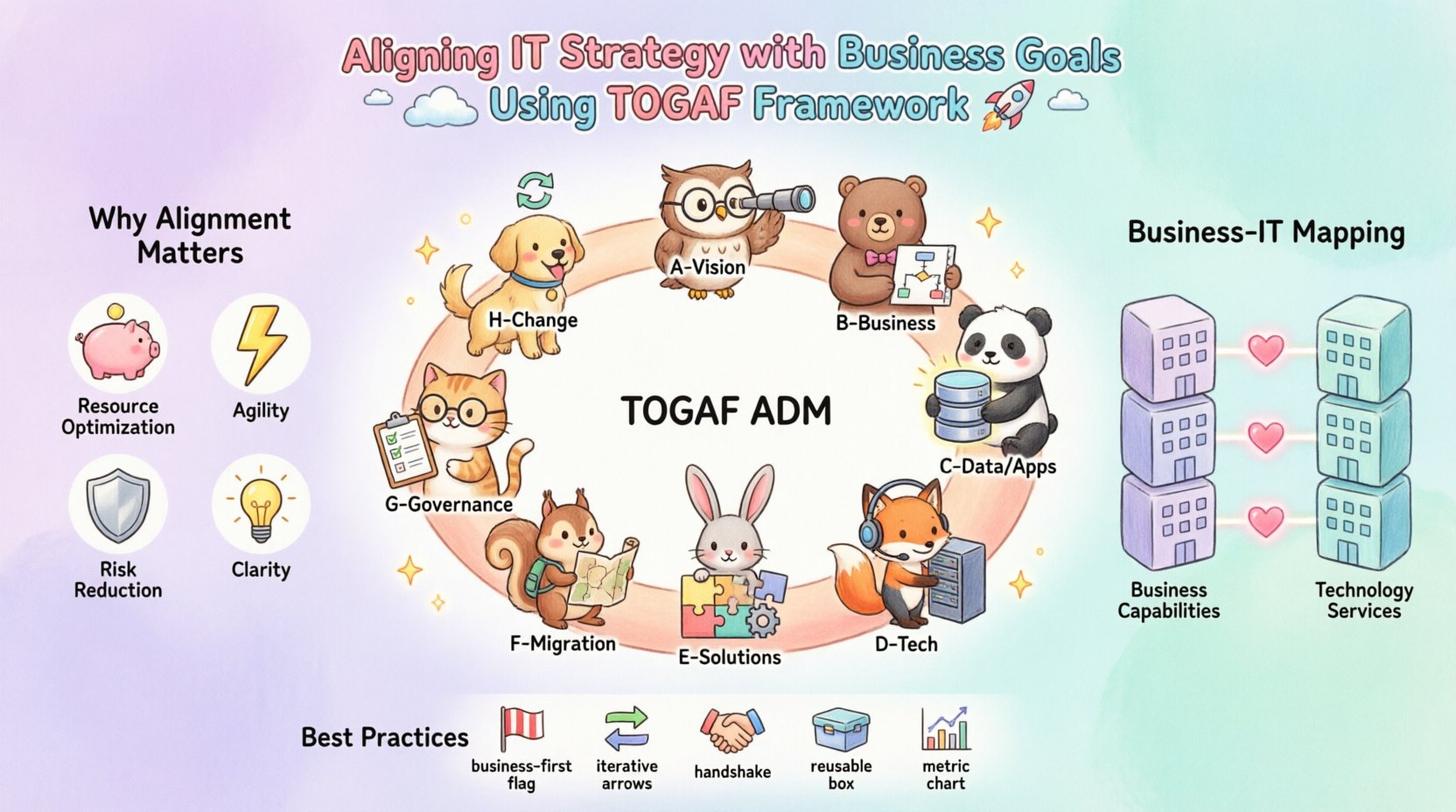
Effective alignment delivers several key benefits:
Resource Optimization: Budget and personnel are directed toward initiatives that directly support revenue or cost-saving goals.
Agility: The organization can respond faster to market changes because the underlying systems are designed for flexibility.
Risk Reduction: Compliance and security standards are embedded into the architecture rather than added as an afterthought.
Clarity: Stakeholders understand how specific technology investments contribute to the broader mission.
Understanding the TOGAF Framework 🧩
The Open Group Architecture Framework (TOGAF) is one of the most widely adopted frameworks for enterprise architecture. It provides a comprehensive approach for designing, planning, implementing, and governing an enterprise information architecture.
TOGAF is not a rigid set of rules but a flexible methodology. It centers around the Architecture Development Method (ADM), a cycle of processes used to develop the architecture. This framework allows organizations to customize the approach to fit their specific needs.
Key Components of TOGAF
To achieve alignment, one must understand the core building blocks:
Architecture Content Framework: Defines the artifacts, such as models and diagrams, used to document the architecture.
Architecture Capability Framework: Establishes the organizational structure and processes required to support architecture work.
Enterprise Continuum: A repository of reusable architecture assets that help in building new solutions efficiently.
TOGAF Content Metamodel: A standard way to describe and organize architecture content.
The Architecture Development Method (ADM) 🔄
The ADM is the heart of TOGAF. It is an iterative process that guides architects from the initial vision to the final implementation. Each phase has specific goals, inputs, and outputs. Understanding this cycle is essential for aligning IT with business.
Below is a detailed breakdown of the ADM phases:
Phase A: Architecture Vision
This phase sets the stage. The primary objective is to define the scope, constraints, and stakeholders. It involves creating an Architecture Vision document that outlines the business drivers and the high-level goals.
Key Activity: Identify business mission, vision, and strategy.
Output: Architecture Vision Document.
Alignment Focus: Ensuring the IT project supports the business mission from day one.
Phase B: Business Architecture
Here, the focus shifts to defining the business strategy, governance, organization, and key business processes. This is critical for alignment because it establishes the context for the technology.
Key Activity: Map business processes and information flows.
Output: Business Architecture Model.
Alignment Focus: Understanding how value is delivered to customers.
Phase C: Information Systems Architectures
This phase is divided into two parts: Data Architecture and Application Architecture.
Data Architecture: Defines the logical and physical data assets and data management resources.
Application Architecture: Provides a blueprint for individual application systems, their interactions, and their relationships to the core business processes.
Phase D: Technology Architecture
This phase describes the hardware, software, and network infrastructure required to support the deployed applications. It ensures the physical infrastructure can handle the demands defined in previous phases.
Key Activity: Select platforms and standards.
Alignment Focus: Ensuring infrastructure supports scalability and reliability.
Phase E: Opportunities and Solutions
In this phase, the focus is on identifying the specific solutions and projects needed to bridge the gap between the Baseline and Target Architectures. It involves developing a Transition Architecture and a detailed Implementation and Migration Plan.
Key Activity: Prioritize projects based on business value.
Output: Implementation Project Plan.
Phase F: Migration Planning
This phase refines the plan developed in Phase E. It ensures that the transition is feasible, manageable, and aligned with business priorities. It addresses risks and resource requirements.
Phase G: Implementation Governance
During the actual build and deployment, this phase ensures that the implementation stays true to the architecture. It involves oversight and guidance to prevent scope creep or deviation from the agreed-upon strategy.
Phase H: Architecture Change Management
Once the architecture is in place, it must evolve. This phase manages changes to the architecture to ensure they remain aligned with changing business goals over time.
Phase | Focus Area | Alignment Outcome |
|---|---|---|
Phase A | Vision | Business Goals Defined |
Phase B | Business | Process Mapping |
Phase C | Data & Apps | Information Flow |
Phase D | Technology | Infrastructure Fit |
Phase E-H | Implementation | Execution Control |
Mapping Business to IT Architecture 🗺️
Aligning IT strategy requires a clear mapping between business capabilities and technical services. This mapping ensures that every piece of technology has a purpose linked to a business outcome.
Business Capability Mapping
Start by defining the business capabilities required to execute the strategy. A capability is a specific ability that an organization possesses, such as “Customer Management” or “Supply Chain Optimization.” Once defined, map these to the applications and data that support them.
Capability: Customer Relationship Management
Application: CRM System
Data: Customer Profiles, Transaction History
Technology: Cloud Servers, Database Management
This traceability allows leadership to see exactly which technology investments drive specific business capabilities. If a capability is no longer relevant, the associated technology can be decommissioned, saving costs.
The Business-IT Value Chain
Establishing a value chain involves tracking how technology inputs are transformed into business outputs. This involves:
Input: IT Resources (Budget, Staff, Tools).
Process: Development, Maintenance, Support.
Output: Applications, Services, Data.
Outcome: Increased Revenue, Reduced Costs, Improved Compliance.
Governance and Compliance 🛡️
Without governance, architecture efforts can drift. Governance ensures that the IT strategy remains consistent with business goals over time. TOGAF provides a mechanism for Architecture Governance.
Key governance activities include:
Compliance: Checking if projects adhere to the defined architecture.
Decision Making: Establishing a body (Architecture Board) to review and approve significant changes.
Monitoring: Tracking key performance indicators (KPIs) related to architecture health.
Effective governance prevents “shadow IT,” where departments purchase and deploy technology without central oversight, which often leads to integration issues and security risks.
Common Challenges in Alignment ⚠️
While the framework is robust, implementation often faces hurdles. Recognizing these pitfalls helps in navigating the journey.
1. Lack of Executive Sponsorship
Enterprise architecture requires support from top leadership. Without it, IT and business units may prioritize their own short-term goals over the long-term architectural vision.
2. Complexity Overload
Trying to document every detail can slow down progress. The goal is to capture enough information to guide decisions, not to create a museum of diagrams. Focus on high-value areas first.
3. Resistance to Change
Architectural changes often require shifts in how people work. Communication is key. Stakeholders need to understand the benefits of the new architecture for their specific roles.
4. Static Architecture
Business environments change rapidly. An architecture that is not reviewed regularly becomes obsolete. The Architecture Change Management phase is critical for maintaining relevance.
Best Practices for Success ✅
To ensure the TOGAF framework delivers value, follow these proven practices.
Start with the Business: Never start with technology. Begin by understanding the business strategy and pain points.
Iterative Approach: Use the ADM cycle iteratively. Small, incremental improvements are often more successful than big-bang transformations.
Engage Stakeholders Early: Involve business leaders in the Architecture Vision phase to ensure buy-in.
Focus on Reusability: Build assets that can be reused across the organization to reduce redundancy.
Measure Value: Define metrics that show the return on investment for architecture initiatives.
Conclusion 🏁
Aligning IT strategy with business goals is not a one-time event but a continuous discipline. The TOGAF Framework provides the structure needed to maintain this alignment. By utilizing the Architecture Development Method, organizations can ensure that their technology investments directly support their mission.
Success depends on clarity, communication, and governance. When the business and IT speak the same language, the organization becomes more resilient and competitive. The path forward requires commitment to the process and a willingness to adapt as the landscape evolves.
Implementing TOGAF is an investment in the future stability and growth of the enterprise. It transforms IT from a cost center into a strategic partner that drives value across the entire organization.