In the modern digital landscape, technology evolves at a pace that often outstrips traditional planning cycles. Organizations that rely on static infrastructure designs frequently face obsolescence, security vulnerabilities, and operational bottlenecks within a few years. To navigate this volatility, a structured approach to planning is essential. Strategic architecture planning, grounded in frameworks like TOGAF (The Open Group Architecture Framework), provides the discipline required to build systems that remain relevant and resilient over time. This guide explores how to align technical capabilities with long-term business goals without relying on transient tools.
Why Strategic Planning Matters for Infrastructure 🚀
IT infrastructure is no longer just about hardware and cables. It encompasses cloud services, data centers, security protocols, network topology, and software interoperability. Without a guiding strategy, organizations often accumulate “technical debt”—a state where quick fixes and short-term solutions create complexity that hinders future development.
Strategic architecture planning addresses this by:
- Aligning Technology with Business Goals: Ensuring every investment supports a specific operational outcome.
- Reducing Complexity: Eliminating redundant systems and standardizing interfaces.
- Enhancing Security Posture: Building security into the design rather than adding it as an afterthought.
- Enabling Scalability: Creating systems that can grow with demand without requiring complete reconstruction.
By adopting a framework-based approach, leaders can make decisions based on data and established principles rather than vendor pressure or immediate trends.
Understanding the TOGAF Framework in Practice 📚
TOGAF is a widely adopted framework for Enterprise Architecture. It offers a method for designing, planning, implementing, and governing an information architecture. While often associated with high-level business strategy, its application to IT infrastructure is profound. It provides a lifecycle known as the Architecture Development Method (ADM) that guides the entire process.
The core value of TOGAF lies in its ability to break down complex problems into manageable phases. It encourages the creation of Architecture Building Blocks (ABBs) and Solution Building Blocks (SBBs). This distinction helps teams understand what is required functionally versus what is being delivered technically.
Key components of the framework relevant to infrastructure include:
- Architecture Vision: Defining the scope and constraints.
- Business Architecture: Understanding the processes the infrastructure must support.
- Data and Application Architecture: Structuring how information flows and interacts.
- Technology Architecture: Defining the hardware, software, and network capabilities.
This holistic view ensures that infrastructure changes are not isolated events but part of a cohesive evolution.
The Architecture Development Method (ADM) Cycle 🔄
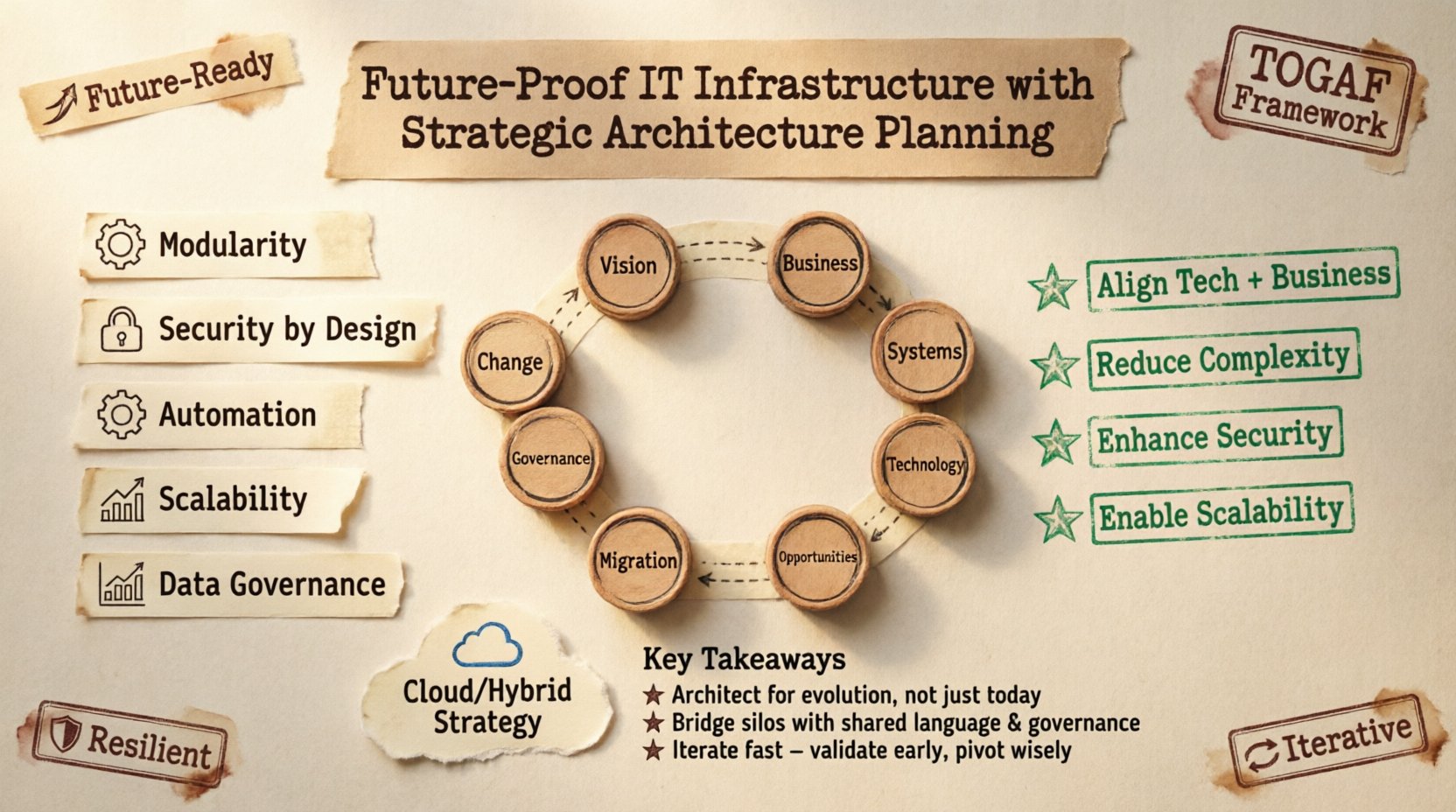
The ADM is the heart of the TOGAF framework. It is an iterative process that ensures architecture is developed systematically. For IT infrastructure, following this cycle prevents gaps in planning and ensures stakeholder alignment. Below is a breakdown of how each phase applies to infrastructure planning.
Phase A: Architecture Vision
This phase sets the stage. Stakeholders define the scope of the infrastructure project, identify constraints, and establish the business case. Key questions include: What are the current pain points? What are the strategic objectives? Who are the key stakeholders? A clear vision document is created to guide all subsequent work.
Phase B: Business Architecture
Before building technology, you must understand the business. This phase maps business processes to the infrastructure requirements. It identifies which services are critical and which can be optimized. For example, a finance team may require higher security standards than a marketing team, influencing the network design.
Phase C: Information Systems Architectures
This phase focuses on Data and Application architectures. It defines how data is stored, managed, and accessed. It also outlines the applications that will run on the infrastructure. Key considerations include data governance, compliance requirements, and application interoperability.
Phase D: Technology Architecture
Here, the physical infrastructure is designed. This includes server specifications, network topology, cloud strategies, and security hardware. The goal is to create a technology blueprint that supports the data and application requirements defined in Phase C.
Phase E: Opportunities and Solutions
This phase identifies the best path forward. It involves evaluating potential solutions and determining which ones align best with the architecture vision. It often involves comparing build versus buy options and assessing the risks associated with different technologies.
Phase F: Migration Planning
Once the target architecture is defined, a transition plan is developed. This outlines the steps required to move from the current state to the future state. It includes scheduling, resource allocation, and risk mitigation strategies.
Phase G: Implementation Governance
During the actual deployment, this phase ensures that the implementation adheres to the architecture standards. It involves oversight, compliance checks, and management of deviations.
Phase H: Architecture Change Management
Infrastructure is never static. This phase establishes a process for managing changes to the architecture over time. It ensures that future modifications are vetted against the original vision to prevent drift.
| Phase | Focus Area | Infrastructure Output |
|---|---|---|
| A | Vision | Strategic Scope Document |
| B | Business | Process Mapping & Requirements |
| C | Systems | Data Models & App Interfaces |
| D | Technology | Network Topology & Hardware Specs |
| E | Opportunities | Solution Selection & Risk Analysis |
| F | Migration | Implementation Roadmap |
| G | Governance | Compliance & Audit Reports |
| H | Change | Change Management Procedures |
Core Pillars of Future-Proof Infrastructure 🛡️
While the ADM provides the process, specific architectural principles ensure the infrastructure remains viable. These pillars form the foundation of a resilient system.
1. Modularity and Interoperability 🧩
Systems should be designed as independent modules that communicate through standard interfaces. This allows teams to replace or upgrade one component without affecting the entire ecosystem. Interoperability ensures that different systems can exchange data seamlessly, preventing silos.
2. Security by Design 🔒
Security cannot be an add-on. It must be embedded in every layer of the infrastructure. This includes network segmentation, identity management, and encryption standards. A zero-trust approach is often recommended, where no user or device is trusted by default.
3. Automation and Orchestration ⚙️
Manual processes introduce errors and slow down operations. Infrastructure should be managed through code and automated workflows. This reduces the time required for provisioning and ensures consistency across environments.
4. Scalability and Elasticity 📈
The infrastructure must handle growth without performance degradation. Elasticity allows resources to scale up during peak demand and scale down during quiet periods. This optimizes costs and performance simultaneously.
5. Data Integrity and Governance 📊
Data is a critical asset. Governance policies must define how data is created, stored, accessed, and deleted. Integrity checks ensure that data remains accurate and reliable over time.
Building a Resilient Network Topology 🌐
The network is the backbone of IT infrastructure. A robust topology supports high availability and disaster recovery. Key considerations include:
- Redundancy: Critical paths should have backups. If one link fails, traffic should automatically reroute.
- Segmentation: Dividing the network into zones limits the spread of threats. For example, separating production systems from development environments.
- Bandwidth Management: Ensuring sufficient capacity for current and future data loads.
- Latency Optimization: Placing resources close to users to improve response times.
When planning the network, organizations should avoid proprietary protocols that lock them into a single vendor. Open standards ensure flexibility and long-term viability.
Cloud Strategy and Hybrid Models ☁️
The shift to cloud computing has transformed infrastructure planning. However, moving everything to the cloud is not always the answer. A hybrid approach often provides the best balance of control and flexibility.
Key considerations for cloud strategy:
- Workload Placement: Determine which applications belong on-premises and which belong in the cloud based on security, latency, and compliance needs.
- Cost Management: Cloud costs can spiral without strict governance. Implementing tagging and budget alerts is essential.
- Portability: Design applications to be portable. This prevents vendor lock-in and allows movement between providers if necessary.
- Resilience: Leverage cloud provider redundancy features to ensure uptime.
Strategic planning dictates the timing and method of migration. Rushing into cloud adoption without a roadmap often leads to misconfigured resources and security gaps.
Governance and Continuous Improvement 📉
Architecture planning does not end with deployment. Continuous improvement is necessary to adapt to new threats and technologies. Governance structures ensure that changes are evaluated before implementation.
Establishing an Architecture Review Board (ARB):
- A cross-functional team that reviews proposed changes.
- Ensures alignment with strategic goals.
- Validates compliance with security and standards.
Metrics for Success:
To measure the effectiveness of the infrastructure, track specific metrics. These might include:
- Uptime: Percentage of time systems are available.
- Mean Time to Recovery (MTTR): How quickly issues are resolved.
- Deployment Frequency: How often updates are released.
- Change Failure Rate: Percentage of changes that cause incidents.
Common Pitfalls to Avoid 🚫
Even with a solid plan, mistakes happen. Being aware of common pitfalls can help avoid costly setbacks.
- Ignoring User Feedback: Technology is built for people. If the infrastructure hinders productivity, it has failed.
- Over-Engineering: Building systems that are too complex for the current needs. Simplicity is often better.
- Lack of Documentation: If the architecture is not documented, it becomes impossible to maintain or troubleshoot.
- Resistance to Change: Staff may resist new processes. Change management is as important as technical planning.
- Short-Term Thinking: Prioritizing immediate cost savings over long-term stability.
Integrating Emerging Technologies 🚀
The technology landscape is constantly shifting. New capabilities like artificial intelligence, edge computing, and quantum computing are emerging. Strategic planning must account for the potential integration of these technologies.
Guidelines for Emerging Tech:
- Evaluate Relevance: Does this technology solve a current or future problem?
- Proof of Concept: Test new technologies in a controlled environment before full deployment.
- Skill Assessment: Ensure the team has the skills to manage new tools.
- Ethical Considerations: Consider the ethical implications of data usage and automation.
Final Thoughts on Sustainable Architecture 🌱
Building an IT infrastructure that lasts requires more than just good hardware. It requires a disciplined approach to planning, execution, and governance. By leveraging frameworks like TOGAF, organizations can create systems that are flexible, secure, and aligned with business objectives.
The journey toward a future-proof infrastructure is ongoing. It demands regular reviews, adaptation to new information, and a commitment to continuous improvement. By focusing on the core pillars of modularity, security, and automation, leaders can ensure their technology investments deliver value for years to come.
Success in this area is not about predicting the future with certainty. It is about building a system capable of adapting to whatever the future holds. With the right strategy in place, organizations can navigate the complexities of the digital age with confidence and clarity.
Key Takeaways for Implementation 📝
- Start with Vision: Define clear goals before selecting technologies.
- Follow a Method: Use structured frameworks like TOGAF ADM to guide the process.
- Design for Change: Assume that requirements will evolve and plan for flexibility.
- Measure and Adapt: Use metrics to track performance and guide improvements.
- Involve Stakeholders: Ensure business and technical teams work together throughout the lifecycle.
By adhering to these principles, IT leaders can build a foundation that supports innovation and resilience. The goal is not just to maintain systems, but to enable the organization to grow and succeed in a dynamic environment.