


Entering international markets presents a complex web of challenges that domestic strategies often fail to address. Companies expanding beyond borders must account for shifting regulations, cultural nuances, and economic volatility. The PEST analysis framework provides a structured method to evaluate these macro-environmental factors. By examining Political, Economic, Social, and Technological forces, organizations can anticipate risks and identify opportunities before committing significant resources.
This guide examines how leading enterprises applied this methodology to secure sustainable growth. We will explore specific scenarios where strategic foresight transformed potential obstacles into competitive advantages. Understanding these dynamics is essential for any organization seeking longevity in a globalized economy.
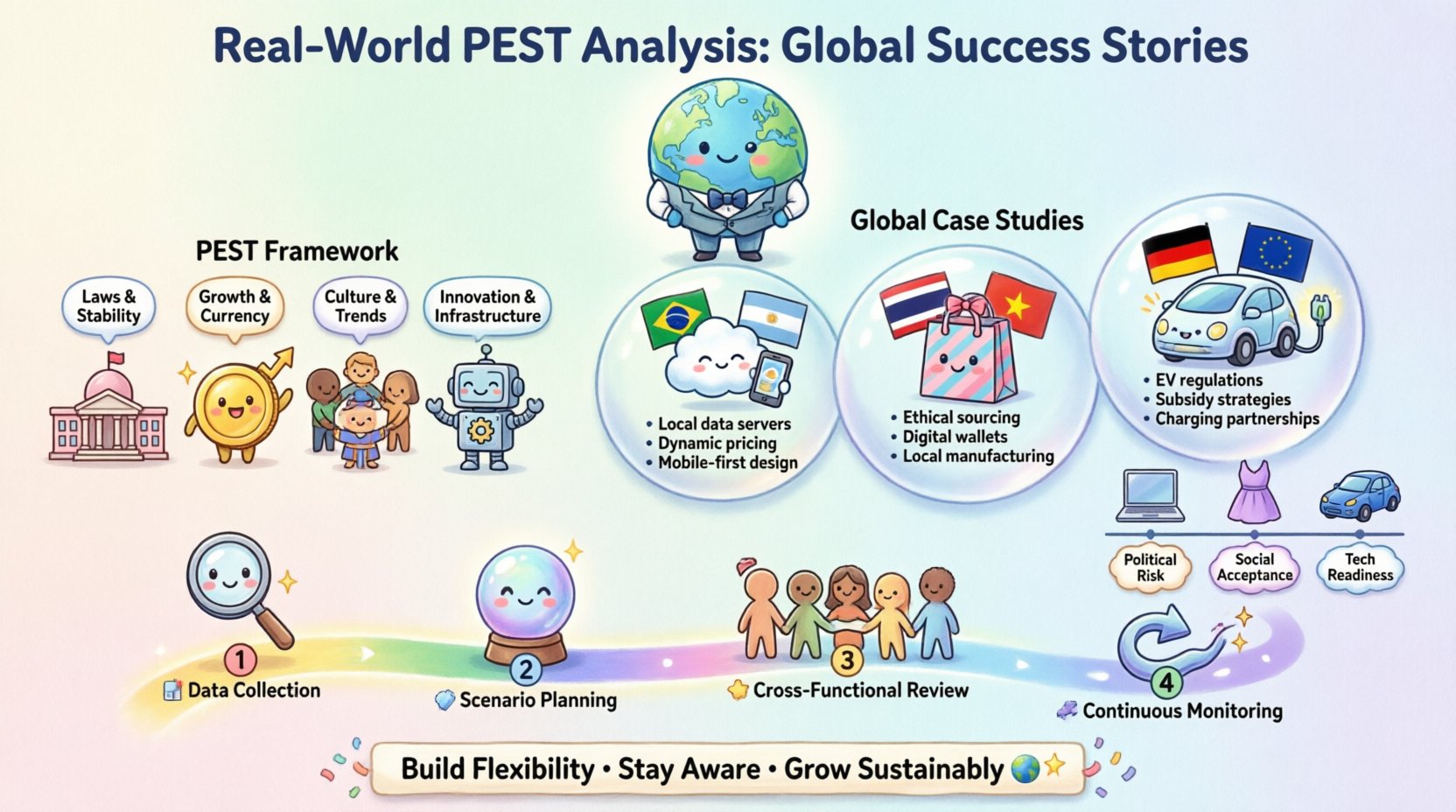
Understanding the Macro-Environmental Framework 🧩
Before diving into specific examples, it is necessary to clarify the components of this analytical tool. It is not merely a checklist but a lens through which external data is interpreted.
- Political Factors: Tax policies, labor laws, trade restrictions, and political stability.
- Economic Factors: Inflation rates, exchange rates, interest rates, and GDP growth.
- Social Factors: Demographic trends, cultural attitudes, health consciousness, and education levels.
- Technological Factors: Innovation speed, automation, R&D activity, and infrastructure quality.
When utilized correctly, this framework prevents decision-makers from relying solely on historical data. It forces the organization to look outward, acknowledging that external forces often dictate the viability of internal strategies.
Case Study 1: Technology Expansion in Latin America 🇧🇷
A major multinational technology corporation planned to launch a cloud-based enterprise solution in Brazil and Argentina. The initial instinct was to replicate the success model from North America. However, a comprehensive PEST analysis revealed significant friction points that required a tailored approach.
Political Landscape and Regulatory Compliance
The political environment in the region was characterized by fluctuating government administrations. The firm identified potential risks regarding data sovereignty laws. Local regulations required data to be stored on servers physically located within the country. This necessitated a shift from a centralized global infrastructure to a distributed node model.
- Key Insight: Data privacy regulations were stricter than anticipated.
- Action Taken: The firm partnered with local hosting providers to ensure compliance.
- Outcome: Avoided potential fines and maintained trust with local government clients.
Economic Volatility and Pricing Strategy
Economic indicators showed high currency volatility. Pricing a subscription model in US dollars posed a risk of pricing out customers during devaluation periods. The analysis highlighted the need for local currency pricing mechanisms.
- Key Insight: Inflation rates varied significantly between the two target nations.
- Action Taken: Implemented dynamic pricing models adjusted for local purchasing power parity.
- Outcome: Retained market share during economic downturns where competitors withdrew.
Social and Technological Adoption
Social factors indicated a rapid shift toward mobile-first internet usage. Technological infrastructure in rural areas was less developed than in urban centers. The firm adjusted its product delivery to ensure functionality on lower-bandwidth networks.
- Key Insight: Mobile penetration exceeded desktop usage in key demographics.
- Action Taken: Optimized the user interface for mobile devices and offline capabilities.
- Outcome: Achieved higher adoption rates among small and medium-sized enterprises.
Case Study 2: Retail Expansion in Southeast Asia 🇹🇭
A global apparel retailer sought to establish a physical footprint in Thailand and Vietnam. The strategy relied heavily on the assumption that Western retail trends would translate directly. A deep dive into the PEST factors revealed the need for a fundamentally different operational model.
Demographic Shifts and Consumer Behavior
Social analysis focused on the younger population demographic. This group prioritized sustainability and ethical sourcing more than previous generations. The retailer’s supply chain, optimized for cost over ethics, faced reputational risk.
- Key Insight: Consumers demanded transparency in sourcing.
- Action Taken: Sourced materials locally to reduce carbon footprint and support local artisans.
- Outcome: Built strong brand loyalty among the youth demographic.
Technological Infrastructure and Payment Systems
Technological factors revealed a cash-dominant culture in rural areas, despite high smartphone usage in cities. The payment ecosystem relied heavily on digital wallets rather than credit cards.
- Key Insight: Credit card penetration was low among the target demographic.
- Action Taken: Integrated multiple local digital payment gateways into the checkout process.
- Outcome: Reduced cart abandonment rates significantly compared to competitors relying on cards.
Regulatory Environment and Import Duties
Political and economic factors intersected regarding import tariffs on raw textiles. The retailer found that importing finished goods was taxed higher than importing raw materials for local manufacturing.
- Key Insight: Local manufacturing incentives were available.
- Action Taken: Established a small manufacturing hub in Vietnam for regional distribution.
- Outcome: Reduced logistics costs and mitigated tariff risks.
Case Study 3: Automotive Manufacturing in Europe 🇩🇪
An automotive manufacturer faced pressure to transition to electric vehicles (EV) while expanding into the European Union. The transition involved navigating complex regulatory landscapes and shifting social attitudes toward internal combustion engines.
Regulatory Pressure and Emissions Standards
Political factors were the primary driver here. The EU mandated strict carbon emission reductions. Non-compliance meant heavy fines and restricted access to major urban centers.
- Key Insight: Legislation was moving faster than the internal R&D timeline.
- Action Taken: Accelerated EV development and phased out legacy models earlier than planned.
- Outcome: Secured market access in key European cities before competitors.
Economic Incentives and Subsidies
Economic factors included government subsidies for EV purchases. These subsidies varied by country, affecting the final price competitiveness.
- Key Insight: Subsidies were being reduced in some regions.
- Action Taken: Adjusted pricing strategies to remain competitive as subsidies tapered.
- Outcome: Maintained profitability margins despite government withdrawal of support.
Social Acceptance and Charging Infrastructure
Social and technological factors intertwined regarding consumer anxiety about charging availability. The analysis showed that infrastructure was the primary barrier to adoption, not price.
- Key Insight: Range anxiety was a major psychological barrier.
- Action Taken: Partnered with charging network providers to offer exclusive access to customers.
- Outcome: Enhanced brand value and reduced customer acquisition costs.
Comparative Analysis of Factors 📊
The following table summarizes how different industries prioritize specific PEST factors during market entry.
| Industry | Primary Political Concern | Primary Economic Concern | Primary Social Concern | Primary Technological Concern |
|---|---|---|---|---|
| Technology | Data Sovereignty | Currency Fluctuation | Mobile Usage | Infrastructure Bandwidth |
| Retail | Import Tariffs | Local Purchasing Power | Ethical Sourcing | Digital Payment Adoption |
| Automotive | Emissions Regulations | Subsidy Reduction | Charging Anxiety | Battery Technology |
Common Pitfalls in PEST Analysis 🚫
Even with robust data, organizations frequently misinterpret the output. Avoiding these common errors ensures the analysis remains actionable.
- Static Analysis: Treating the environment as fixed. Markets change rapidly, requiring regular updates to the assessment.
- Ignoring Interdependencies: Failing to see how a political decision impacts economic stability. For instance, a trade war affects currency exchange rates.
- Over-reliance on Secondary Data: Using outdated reports instead of gathering primary data from local stakeholders.
- Confirmation Bias: Only looking for data that supports a pre-determined decision rather than challenging assumptions.
- Lack of Integration: Keeping the analysis in a separate document rather than integrating it into the strategic planning process.
Implementation Framework for Strategic Planning 📝
To ensure the insights lead to action, organizations should adopt a structured approach to integration. This does not require complex software but rather disciplined processes.
Step 1: Data Collection
Gather information from diverse sources. Government reports, industry publications, and local news outlets provide a baseline. Engaging with local consultants adds context that raw data lacks.
- Identify relevant government bodies for each factor.
- Subscribe to regional economic newsletters.
- Monitor social media trends for cultural shifts.
Step 2: Scenario Planning
Develop multiple scenarios based on the data. What happens if regulations tighten? What if a recession hits? Prepare contingency plans for each scenario.
- Create a “Best Case” scenario for resource allocation.
- Create a “Worst Case” scenario for risk mitigation.
- Define trigger points for switching strategies.
Step 3: Cross-Functional Review
Involve teams from finance, operations, and marketing. Different departments interpret risk differently. A unified view prevents blind spots.
- Hold workshops to discuss findings.
- Assign ownership of specific factors to department heads.
- Document decisions and the rationale behind them.
Step 4: Continuous Monitoring
Establish a system for tracking changes. Assign a team to monitor key indicators weekly or monthly.
- Set up alerts for regulatory changes.
- Review economic data upon release of quarterly reports.
- Conduct annual deep-dive reviews of the full framework.
Strategic Implications for Growth 🚀
Applying this framework goes beyond risk management. It informs where to invest, where to pull back, and how to position the brand. Companies that ignore these external forces often find themselves reacting too late to changes that render their business models obsolete.
The case studies demonstrate that success is not about predicting the future with certainty. It is about building flexibility into the strategy. When a company understands the political and economic landscape, it can pivot faster than competitors who are blind to these shifts.
Furthermore, this approach fosters a culture of external awareness. Employees at all levels become attuned to market conditions. This creates a more agile organization capable of responding to disruption.
Final Thoughts on Global Strategy 🌏
Navigating global markets requires more than just a great product. It demands a deep understanding of the environment in which that product exists. The PEST analysis serves as a foundational tool for this understanding.
By examining political stability, economic health, social trends, and technological readiness, firms can make informed decisions. The examples provided show that while the factors vary by industry, the methodology remains consistent. Success lies in the execution of the insights gained.
Organizations must commit to regular reviews. The world changes, and strategies must evolve to match. Those who prioritize macro-environmental analysis will find themselves better positioned to weather storms and capitalize on opportunities in the global marketplace.
Ultimately, the goal is sustainable growth. This requires looking beyond the immediate horizon and understanding the forces that shape the long-term trajectory of the market. By integrating these insights into daily operations, companies build resilience that lasts for years.
Related posts:
 How to Execute a PEST Analysis for Your International Business Strategy: A Step-by-Step Walkthrough
 PEST Analysis vs. SWOT: A Direct Comparison for MBA Students to Avoid Common Pitfalls
 The 3-Step Quick Start Guide to Conducting a PEST Framework in Under an Hour
 PEST Analysis Component Breakdown: Decoding Political, Economic, Social, and Tech Factors