


The landscape of systems engineering is undergoing a significant transformation. For years, Systems Modeling Language (SysML) has served as the backbone for defining complex requirements, behaviors, and structures. However, the horizon is shifting toward a more integrated approach where models do not merely document designs but actively synthesize executable artifacts. This transition represents a move from passive documentation to active engineering synthesis.
In this comprehensive guide, we examine the trajectory of automated code generation within the SysML ecosystem. We will explore the technical underpinnings, the necessary architectural shifts, and the strategic preparation required for engineering teams. The goal is to establish a robust workflow where models drive implementation without losing fidelity or introducing unmanaged complexity.
🛠️ Current State of Model-Driven Engineering
Today, many organizations utilize SysML to create high-level abstractions. These models often serve as a single source of truth for stakeholders, facilitating communication between hardware, software, and systems engineering disciplines. Despite this success, a gap frequently exists between the model and the final deployed system. This gap is typically bridged by manual translation processes, which introduce the potential for human error and drift between the design intent and the implementation.
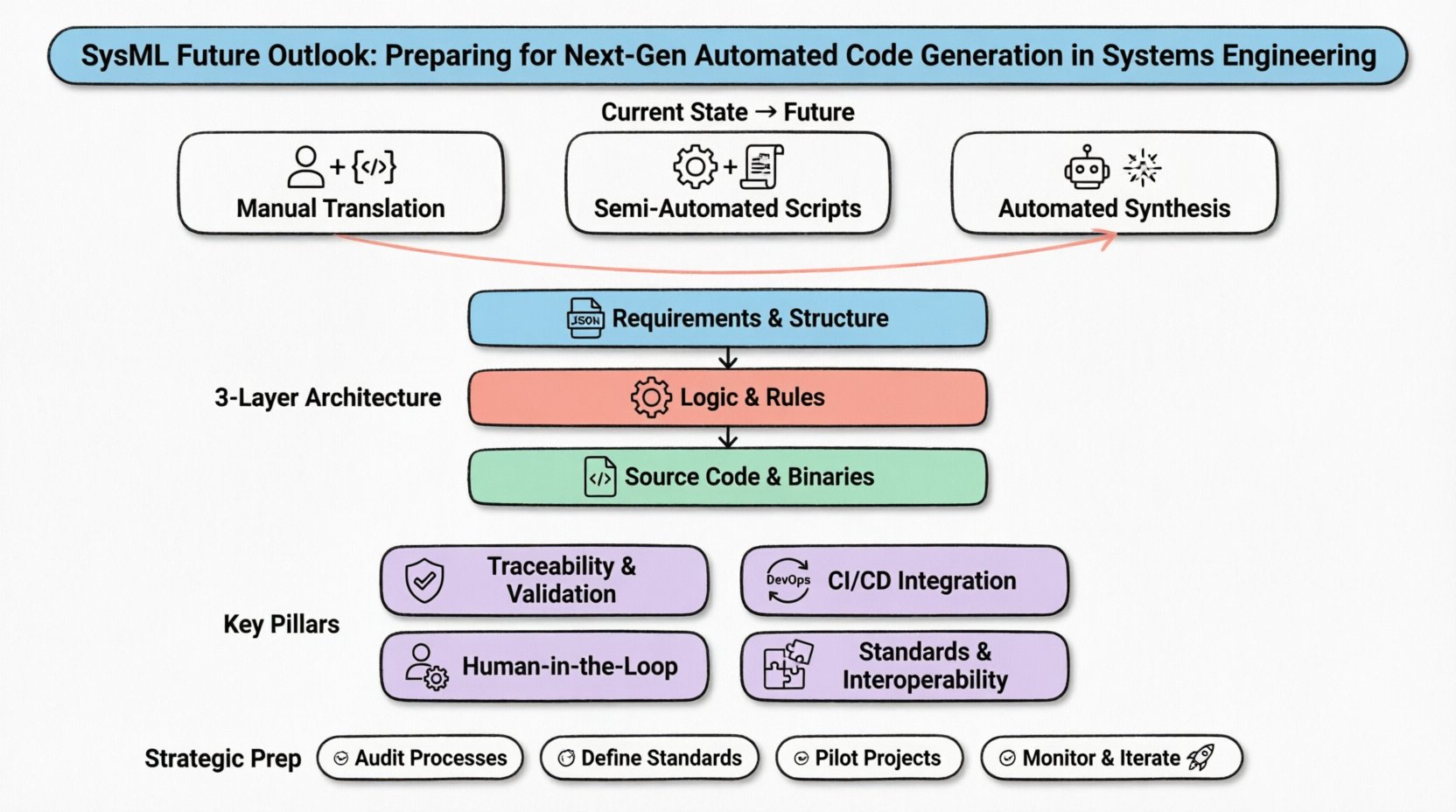
The current state of Model-Driven Engineering (MDE) in this context can be categorized into three primary approaches:
Manual Translation: Engineers read diagrams and write code directly. This is labor-intensive and prone to inconsistencies.
Semi-Automated Scripts: Custom scripts extract data from model repositories to generate boilerplate code. While faster, these often require significant maintenance and lack semantic depth.
Standard Transformations: Established patterns exist for converting specific SysML diagrams into code stubs. These are useful for structure but often struggle with dynamic behavior.
The limitation of the current state is that the generation process is often brittle. Changes in the model frequently require rework in the generation scripts, creating a fragile pipeline. The industry is moving toward a more resilient architecture where the transformation logic is decoupled from the specific model syntax, allowing for greater adaptability.
⚙️ The Shift Towards Automated Synthesis
Automated code generation is not a new concept, but its application in complex systems engineering is evolving. The next generation of tools and processes focuses on semantic fidelity. This means the generated code must not only compile but also accurately reflect the logical constraints, state transitions, and data flows defined in the SysML model.
This shift relies on several key technological drivers:
Enhanced Metamodeling: Advanced definitions of the language structure allow for more precise extraction of behavioral logic.
Graph Transformation Engines: These engines process the model as a graph, applying rules to navigate relationships and generate code segments dynamically.
Constraint Solving: Integration with constraint solvers ensures that generated code adheres to the safety and timing constraints defined in the requirements.
When implementing these technologies, the focus is on reducing the cognitive load on engineers. By automating the translation of state machines and activity diagrams, engineers can focus on the logic and architecture rather than syntax details. This allows for a higher level of abstraction during the design phase.
🏗️ Technical Architecture of Future Code Generation
To support automated synthesis effectively, the underlying architecture of the modeling environment must be robust. A modern generation pipeline typically consists of three distinct layers: the Model Layer, the Transformation Layer, and the Artifact Layer.
1. The Model Layer
This layer contains the SysML models. It must support versioning, branching, and conflict resolution. For code generation to be reliable, the model must be well-formed. Validation rules should be enforced at the model entry point to prevent invalid states from propagating into the generation process.
2. The Transformation Layer
This is the core logic engine. It reads the model data and applies transformation rules to produce intermediate representations. In advanced setups, this layer might utilize domain-specific languages (DSLs) to describe the transformation rules themselves, making them easier to audit and modify.
3. The Artifact Layer
This layer handles the final output. It includes the source code, configuration files, and documentation. It must be compatible with the target build environment. This layer often interfaces with existing continuous integration tools to ensure the generated artifacts are immediately testable.
The following table outlines the responsibilities of each layer:
Layer | Primary Responsibility | Key Output |
|---|---|---|
Model | Define requirements and structure | XML/JSON Model Files |
Transformation | Apply logic and rules | Intermediate Code/AST |
Artifact | Produce deployable files | Source Code, Binaries |
🛡️ Challenges in Verification and Validation
One of the most critical aspects of automated code generation is ensuring the output is correct. If the model is correct but the generator introduces errors, the system is compromised. Verification and Validation (V&V) must be integrated into the generation pipeline, not treated as a separate step.
Key challenges include:
Traceability: Ensuring that every line of generated code can be traced back to a specific element in the SysML model. Without this, debugging becomes nearly impossible.
Behavioral Equivalence: Proving that the runtime behavior of the generated code matches the simulation behavior of the model. State machines are particularly prone to subtle timing discrepancies.
Tool Chain Compatibility: Ensuring the generated code works with the target compiler and operating system. Different languages and platforms have different standards and libraries.
To address these challenges, teams often employ a Round-Trip Engineering approach. This involves generating code, compiling it, and then reading the execution results back into the model to verify consistency. If discrepancies are found, the model is updated, and the cycle repeats. This ensures that the model remains the authoritative source of truth.
🔄 Integration with DevOps and CI/CD Pipelines
Automated code generation fits naturally into modern DevOps practices. In a continuous integration and continuous deployment (CI/CD) environment, the SysML model becomes the trigger for the build pipeline. When a model change is committed, the generation process runs automatically, followed by compilation, testing, and packaging.
This integration offers several benefits:
Faster Feedback Loops: Engineers receive immediate feedback on whether their model changes result in valid code.
Consistent Builds: The generation process is deterministic, ensuring that the same model always produces the same code artifacts.
Reduced Manual Error: Manual steps in the build process are minimized, reducing the risk of human error.
However, integrating model generation into CI/CD requires careful configuration. The generation process can be computationally expensive, so caching strategies are necessary. Additionally, the pipeline must handle failures gracefully. If the generation step fails, the pipeline should halt and notify the team immediately, preventing broken code from being merged.
👤 Human-in-the-Loop Considerations
Despite the advances in automation, the role of the engineer remains central. Fully autonomous generation is not yet feasible for complex, safety-critical systems. The human element is required for architectural decisions, constraint setting, and exception handling.
Effective workflows maintain a balance between automation and human oversight:
Review Gates: Critical sections of generated code should be reviewed by senior engineers before deployment.
Override Mechanisms: Engineers should have the ability to inject manual code into the generated output for specific edge cases.
Training: Engineers need to understand the limitations of the generation tools. They must know when to trust the output and when to intervene.
This approach ensures that the system retains the flexibility of human creativity while leveraging the efficiency of automation. The goal is not to replace engineers but to augment their capabilities.
🔗 Standards and Interoperability
As the industry moves toward automation, interoperability becomes a key concern. Different modeling tools and code generation engines must be able to exchange data seamlessly. Adherence to open standards is essential to prevent vendor lock-in and ensure long-term maintainability.
Key areas of standardization include:
Model Exchange Formats: Using standardized file formats for model data ensures that models can be moved between different tools without data loss.
Transformation Languages: Common languages for describing transformation rules allow for easier sharing of generation logic across teams.
APIs: Open Application Programming Interfaces enable custom integrations with external systems, such as requirements management or test management tools.
Organizations should prioritize tools and platforms that support these standards. This future-proofs the engineering investment and allows for the adoption of new tools as they become available without disrupting the entire workflow.
🎓 Skills Required for the Next Generation Engineer
The rise of automated code generation changes the skill set required for systems engineers. While domain knowledge remains critical, technical proficiency in model transformation and software engineering practices becomes equally important.
Essential skills include:
Model Analysis: The ability to read and understand complex model structures and ensure they are well-formed.
Scripting and Automation: Proficiency in scripting languages used for customizing generation logic and managing pipelines.
Software Architecture: Understanding how the generated code fits into the broader software architecture and how it interacts with other systems.
Quality Assurance: Knowledge of testing strategies specific to model-generated code, including unit testing and integration testing.
Training programs should focus on these areas to prepare the workforce for the evolving landscape. Continuous learning is necessary as the tools and standards continue to evolve.
📋 Summary of Strategic Preparation
Preparing for the next generation of automated code generation requires a strategic approach. It is not just about adopting new tools; it is about rethinking the engineering process. Organizations must invest in training, establish clear standards, and build robust pipelines that integrate seamlessly with existing workflows.
Key steps for preparation include:
Audit Current Processes: Identify bottlenecks and areas where manual translation is causing delays or errors.
Define Standards: Establish clear guidelines for model quality and generation output.
Pilot Projects: Start with small, controlled projects to test generation tools and refine the workflow before scaling.
Monitor and Iterate: Continuously measure the effectiveness of the generation process and make adjustments as needed.
The future of systems engineering lies in the seamless integration of models and code. By embracing automation while maintaining rigorous oversight, organizations can achieve higher quality systems in less time. The transition is challenging, but the rewards in terms of efficiency and reliability are substantial.
⚡ Conclusion
The evolution of SysML and automated code generation represents a pivotal moment in systems engineering. It offers the potential to bridge the gap between design and implementation more effectively than ever before. By understanding the technical architecture, addressing validation challenges, and preparing the workforce, organizations can navigate this transition successfully. The focus remains on creating robust, reliable systems through a disciplined, model-driven approach.